Paraty's historic centre is one of the most complete colonial towns in the Americas, and it rewards anyone who knows how to read it. This is our guide to the buildings, the cobblestones, the tides and the four churches that still tell the town's whole social history.
Most people come to Paraty for the bay and the islands, and then spend their first morning unexpectedly captivated by a few hundred metres of whitewashed houses and uneven stone. The historic centre is small enough to cross in ten minutes, but it is one of the most complete Portuguese colonial towns left standing anywhere in the Americas, and almost nothing in it is decorative by accident. The thick walls, the coloured window frames, the domed cobblestones, the streets that flood on purpose, the four churches built for four different groups of people — all of it was put there for a reason, and once you can read those reasons the town stops being a pretty backdrop and starts being a story.
We host guests on the ridge above the town, and the colonial centre is the one thing we tell everyone to do properly rather than in passing. This is the long version of what we'd say if we walked you down there ourselves: how the town was built, what to look at, which churches are which and who they were for, and how to walk the grid so it makes sense. If you want the wider context first, our complete guide to Paraty sets the scene, and the history of Paraty goes deeper on the gold-port years that paid for all of this.
Why an entire colonial town is still standing
The short answer is bad luck, followed by good luck. Paraty grew rich in the 1700s as the port for the gold of Minas Gerais, which came down out of the mountains along the stone-paved Caminho do Ouro — the Gold Trail — to be loaded onto ships bound for Rio and Lisbon. That gold money built the houses, the churches and the merchant warehouses you walk past today. Then the town was bypassed: a new mountain road let the gold reach Rio without the sea voyage, the later coffee boom ran its wealth through other towns, and Paraty slid into a long, quiet poverty.
That poverty is exactly why the town survived. For more than a century Paraty was too marginal to modernise and too poor to knock anything down, reachable mainly by boat, half-forgotten. Nothing was demolished to build something taller, because there was no money to build anything at all. By the time the coast road reached the town again in the 1970s, the rest of Brazil had realised that the thing which had made Paraty poor had also made it rare: a whole 18th-century town, more or less intact. In 2019 the town and its surroundings were inscribed as Brazil's first mixed UNESCO World Heritage Site, recognised at once for this colonial fabric and for the rainforest and bay around it.
Reading the houses: whitewash, thick walls and coloured frames
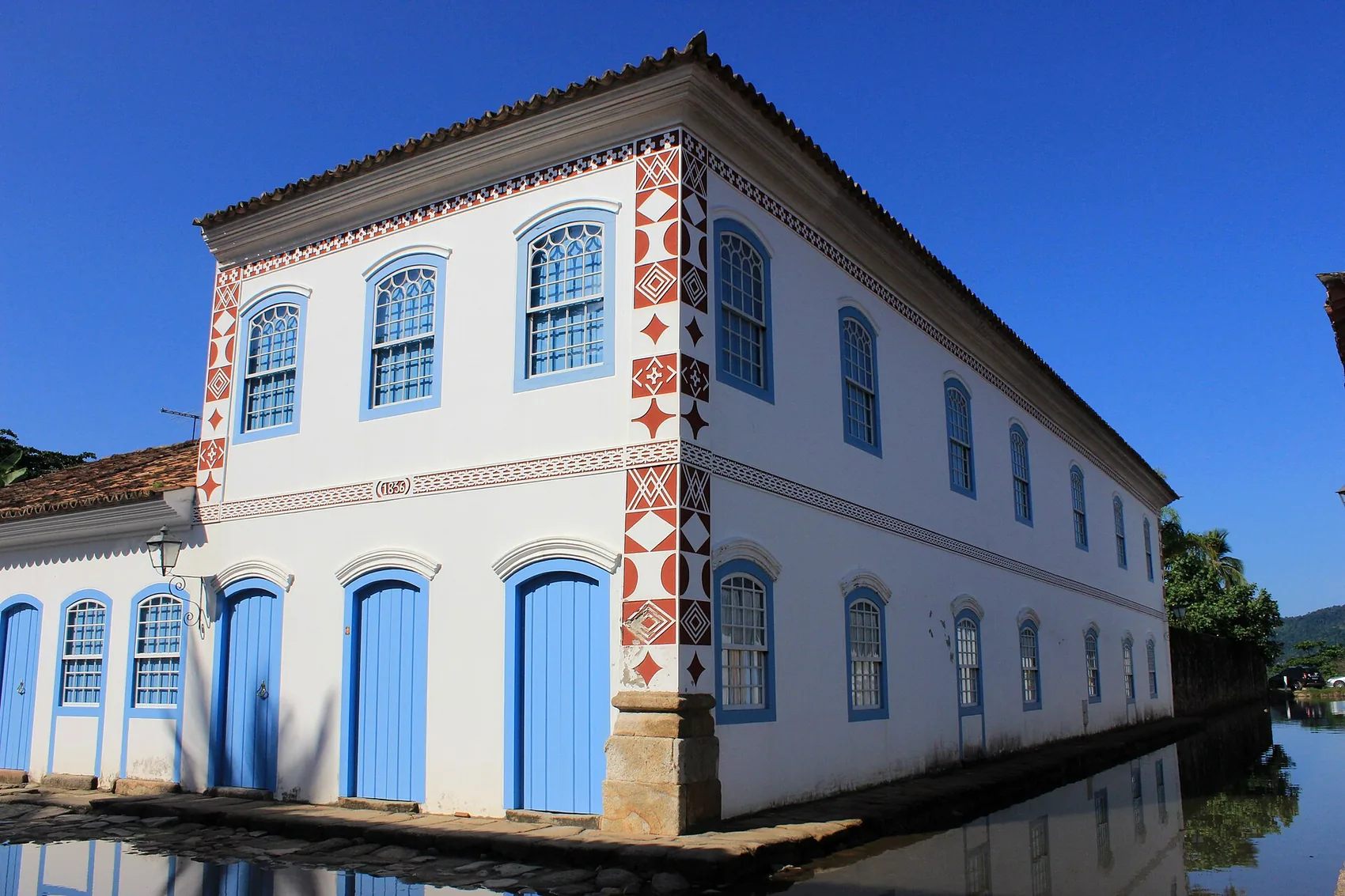
Stand on any corner of the grid and the buildings tell you what they are before you read a single plaque. The standard Paraty house is one or two storeys, built of thick walls — stone, rubble, and a local mud-and-timber technique — finished in lime whitewash that is kept deliberately, almost aggressively white. Against that white, every door and window is outlined in a single strong colour: deep blue most often, but also ochre, oxblood red, green and indigo. The contrast is the whole look of the town, and it is protected: owners in the historic centre can't simply repaint as they please, because the colours and proportions are part of what UNESCO and Brazil's heritage institute, IPHAN, list and police.
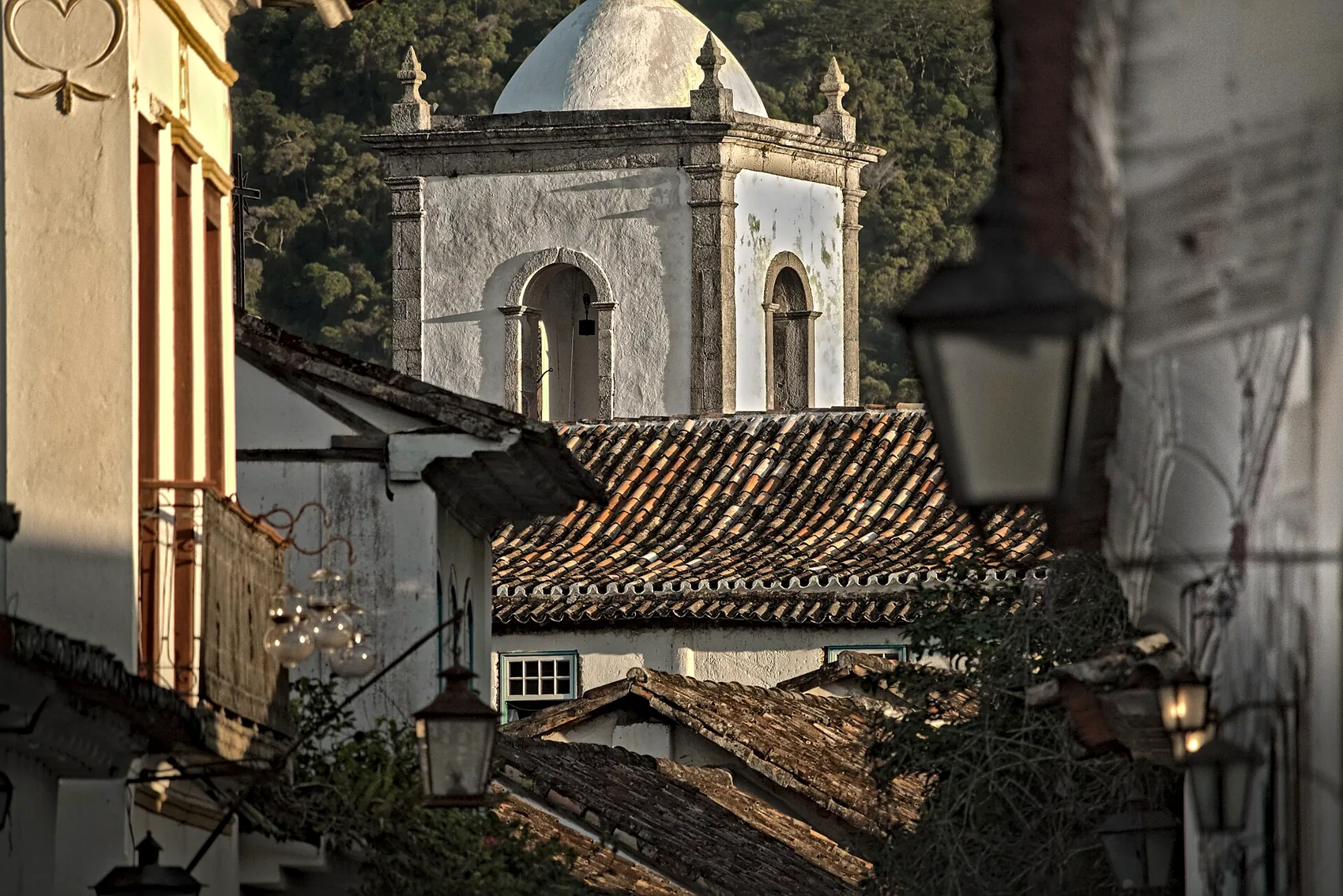
The thick walls are not for looks. They keep the interiors cool through the coastal heat and damp, and they carry the heavy clay-tiled roofs without steel. Look up at those roofs from a rise and you see a sea of warm terracotta tiles, hand-shaped and overlapped, sloping to throw the heavy summer rain clear of the walls. The deep eaves do the same job at ground level, shading the whitewash and the people walking under them.
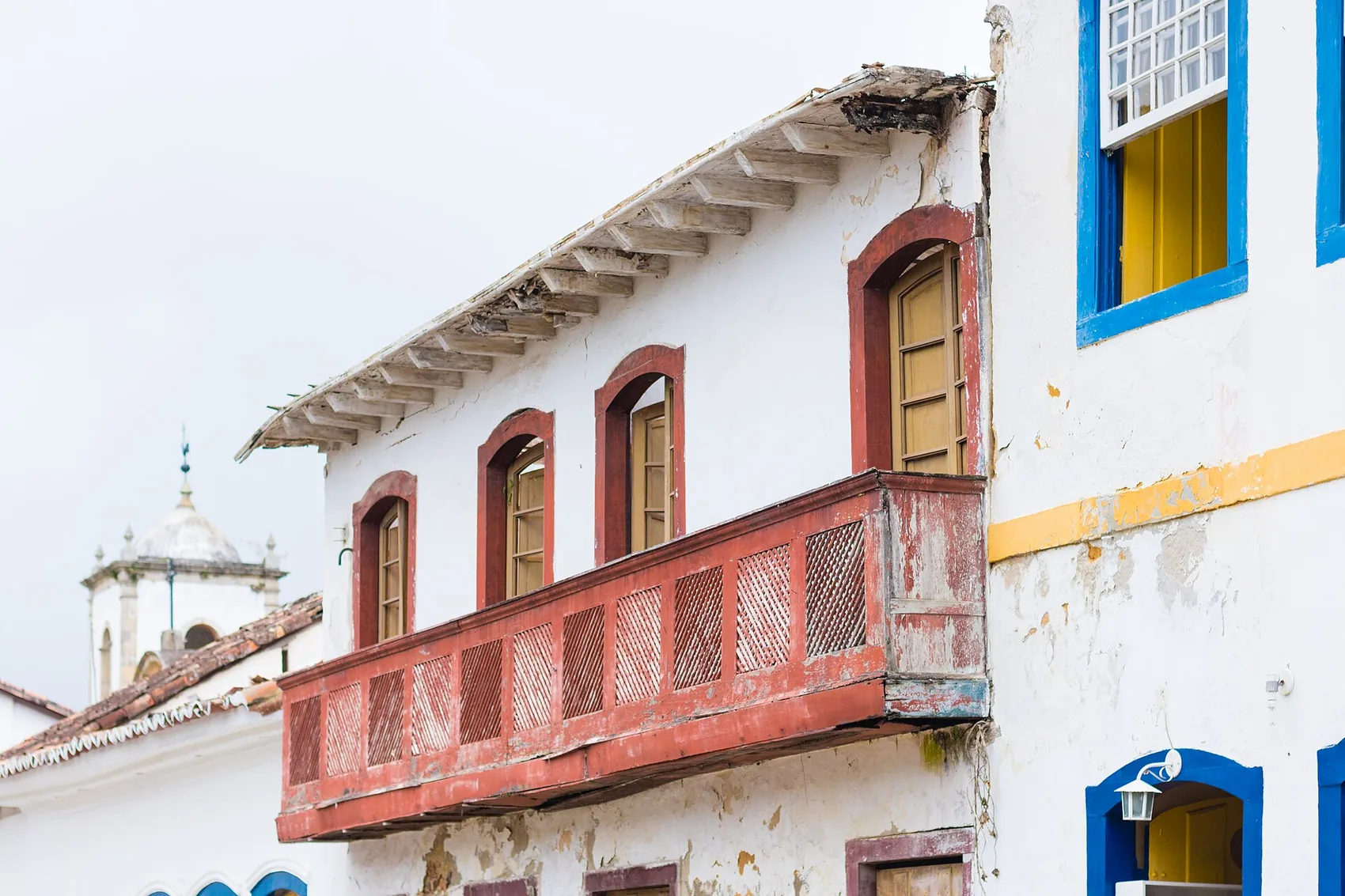
A few details reward a closer look as you walk:
- The doors and windows themselves. The older ones are solid timber, often with carved panels, and the very oldest windows have lattices or shutters rather than glass — Brazil made little window glass in the colonial period, so air and light were managed with wood. On the grander houses you'll see fanlights and ironwork balconies above the street.
- The thresholds. Because the lowest streets were built to flood (more on that below), many houses sit a step or two above the cobbles, with a raised stone sill at the door to keep the tide out. That step is a clue to how low and how flood-prone that particular street is.
- The corner stones. On the older buildings the corners are reinforced with dressed stone blocks, sometimes left unpainted against the whitewash — partly structural, partly a quiet display of the money it took to cut and set them.
None of this is grand in the way a European cathedral city is grand. Paraty was a working port, and most of its buildings were merchants' houses, warehouses and homes, not palaces. The beauty is in the consistency: street after street of the same honest materials, the same proportions, the same white-and-colour rhythm, almost unbroken. That coherence is rarer and harder to keep than any single showpiece, and it is the real reason the town is listed.
The pe-de-moleque cobblestones
You will feel the streets before you've finished admiring them. Paraty is paved with pe-de-moleque — literally "urchin's foot" or "brat's foot" — huge, irregular, rounded stones laid by hand without mortar. They are domed, set higher in the middle of the street and falling away to gutters at the sides, so that rain and tide drain off the crown of the road toward the walls. It is a deliberate, clever piece of drainage engineering, and it is also genuinely hard to walk on. There is no flat stretch and no straight line in the whole grid.
The stones have a history of their own. Many of them arrived as ballast in the empty holds of ships that had come to collect gold and cane spirit, dumped on the quay and then set into the streets — some of them quite literally carried across the Atlantic from Portugal. And the laying of them, like most of the heavy work in colonial Paraty, was done by enslaved people. The name pe-de-moleque comes from the way the stones were bedded in: pressed and worked down into the ground until each one sat firm. It is a small, hard reminder that the picturesque surface you're photographing was built by people who had no choice in the matter.
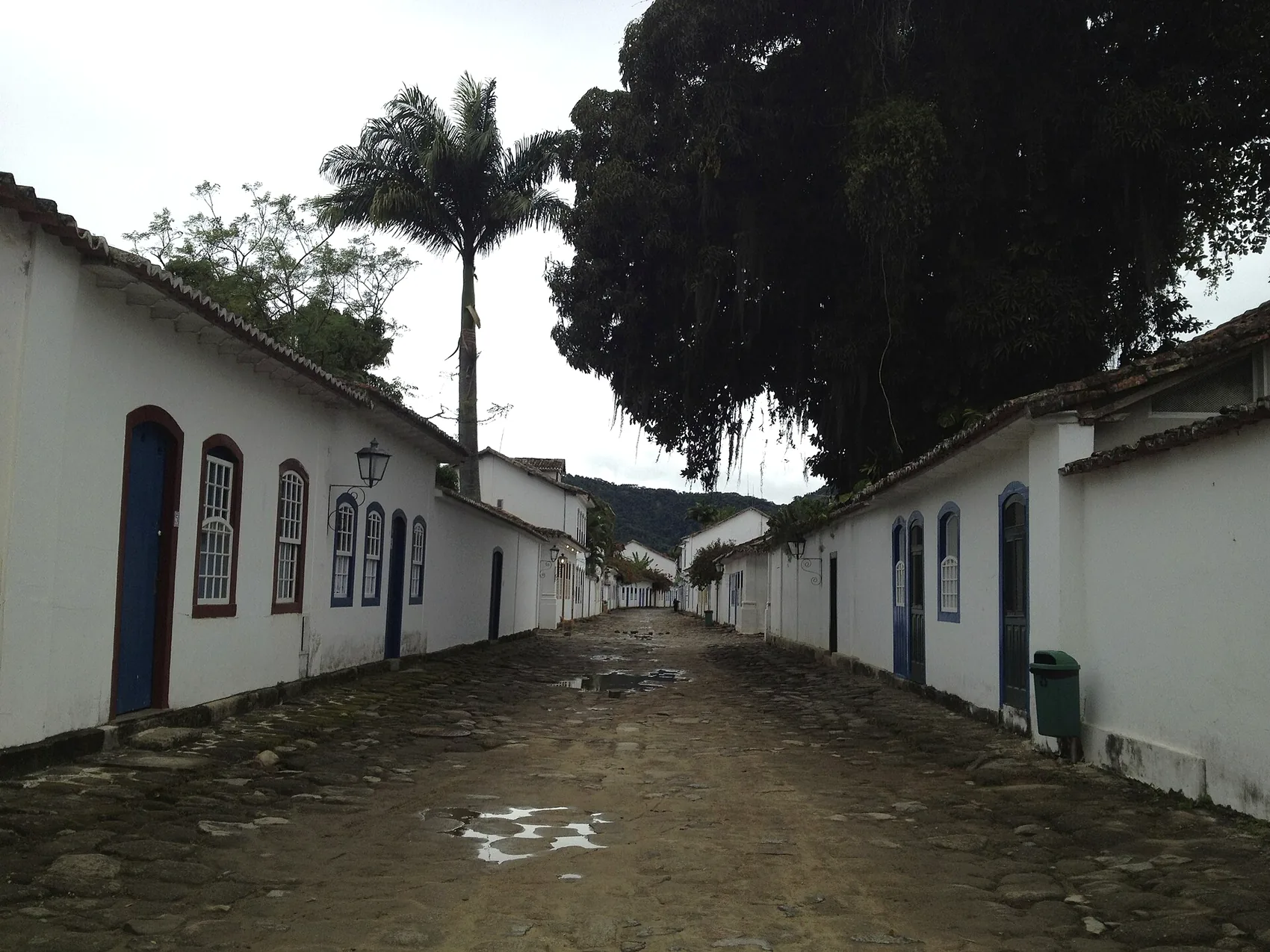
The practical lesson is simple and we repeat it to every guest: wear flat, grippy shoes, watch where you put your feet, and forget about wheeled suitcases, heels or anything that needs a smooth surface. People with limited mobility can still enjoy the town, but should go slowly, take a stick or an arm, and pick the smoother edges of the streets. The cobbles are part of why the centre is car-free, and the car-free quiet is a large part of why the town is so pleasant — so the difficult walking is a feature, not a fault.
The streets that flood on purpose
The strangest and most delightful thing about Paraty is its tides. The lowest streets near the waterfront were laid, deliberately, to flood at the highest spring tides — the big tides that come around the full and new moon. Seawater slides in through gaps left in the seawalls, spreads across the cobbles, washes them clean of dust and debris, and then drains back out as the tide drops. The water is usually only ankle- to shin-deep and it clears within an hour or two. It is not a flood in the disaster sense and it is not a fault in the drainage. It is 18th-century street-cleaning, still working.
When it happens, the effect is unforgettable. The whitewashed houses and coloured frames double in the still water, and the streets become mirrors — a perfect upside-down town under the real one. Photographers plan whole trips around it. The timing depends on the lunar calendar and the local tide table, so if you want to see it, the move is to check the tide times for your dates once you're here, or simply ask us and we'll tell you when the next big tide falls during your stay.
Paraty is one of the only places where getting your feet wet in the street is the whole point, not an accident.
It's worth understanding why this matters beyond the photograph. The tidal streets are a piece of living infrastructure, not a museum reconstruction — the same gaps in the same walls doing the same job they were built for nearly three centuries ago. The whole urban layout, the relationship between the streets and the sea, is part of what is protected under the UNESCO listing. So when the tide comes up over the cobbles, you are watching the town work exactly as its colonial builders intended. Few historic centres anywhere are still that alive.
The four churches, and who they were for
Paraty's four historic churches look, to a casual eye, like four pretty white buildings scattered through the town. They are something much more interesting than that: a map of colonial society in stone. In the rigid, slave-based world of 18th-century Brazil, you did not all worship in the same room. Different groups — defined by colour, status and wealth — built and used different churches, and Paraty's four survive almost as a complete set. Walking between them, in order, is the clearest social history lesson the town offers.
A general caution before the specifics: exact founding dates, dedications and rebuilding histories for these churches vary between sources, because they were built, demolished, rebuilt and re-consecrated over a century and more. We give the dates that are most commonly cited and flag them as approximate. What is solid and well documented is who each church was for, and that is the part worth carrying around the streets with you.
Igreja de Santa Rita — the freed mixed-race Catholics
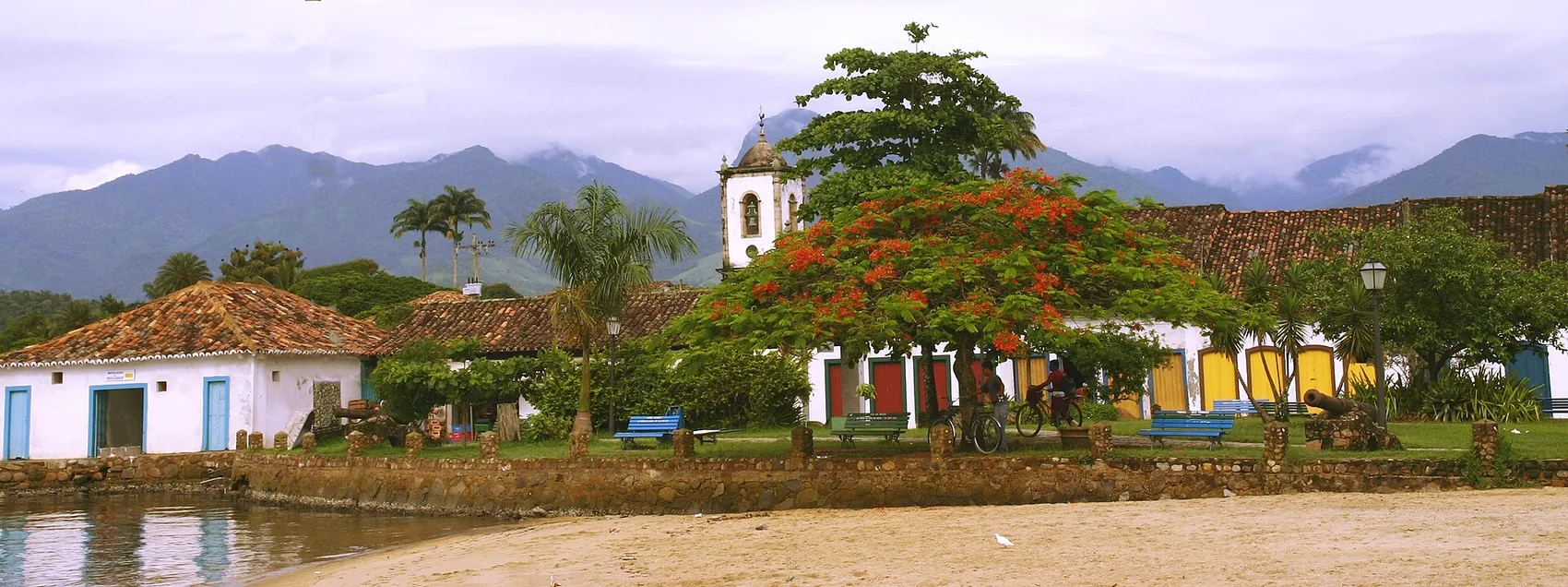
Start where the photographs start. The little Igreja de Santa Rita stands right at the water's edge, its three-tiered white facade and small bell tower forming the single most photographed view in Paraty. It is usually dated to 1722 and is generally cited as the oldest surviving church in the centre. Crucially, it was built by and for Paraty's free mixed-race Catholics — the pardos libertos, men and women of mixed African and European descent who had gained their freedom and wanted a place of their own to worship, since the wealthier white churches were not open to them.
That social fact is the church's real meaning, and it sits oddly and powerfully against its fame. The most famous, most painted, most postcarded building in this colonial town was the church of people the colonial order placed near the bottom of it. Architecturally it is admired too: the great modernist architect and urbanist Lucio Costa, who shaped Brazil's approach to heritage, considered Santa Rita the finest building in Paraty. Today the church houses the town's museum of sacred art, a small collection of colonial religious images, silverwork and liturgical objects. Hours are short and change with the season, so check locally, but if it's open the museum is well worth the modest ticket.
Igreja de Nossa Senhora do Rosario — enslaved and free Black Catholics
A couple of blocks inland stands the Igreja de Nossa Senhora do Rosario e Sao Benedito, the church of Paraty's enslaved and free Black population. Across colonial Brazil, brotherhoods of Our Lady of the Rosary were the great Black Catholic institutions — lay associations that, within the brutal limits of a slave society, gave their members a place to worship, to bury their dead with dignity, to pool money, and sometimes to buy freedom. Paraty's Rosario church, usually dated to the second quarter of the 1700s and rebuilt later in the century, was the home of that brotherhood here.
It is the plainest of the four churches, and that plainness is itself the history: it was built and maintained by people who had the least, often with their own hands and their own scarce money, in time stolen from forced labour. The gold economy that paid for Paraty's wealth ran on slavery, and this is the building where that truth is least hidden. The church still holds its festivities, traditionally in November, with processions and the crowning of a symbolic king and queen — living echoes of the brotherhood's centuries-old role. If you visit only one church for what it means rather than how it looks, make it this one.
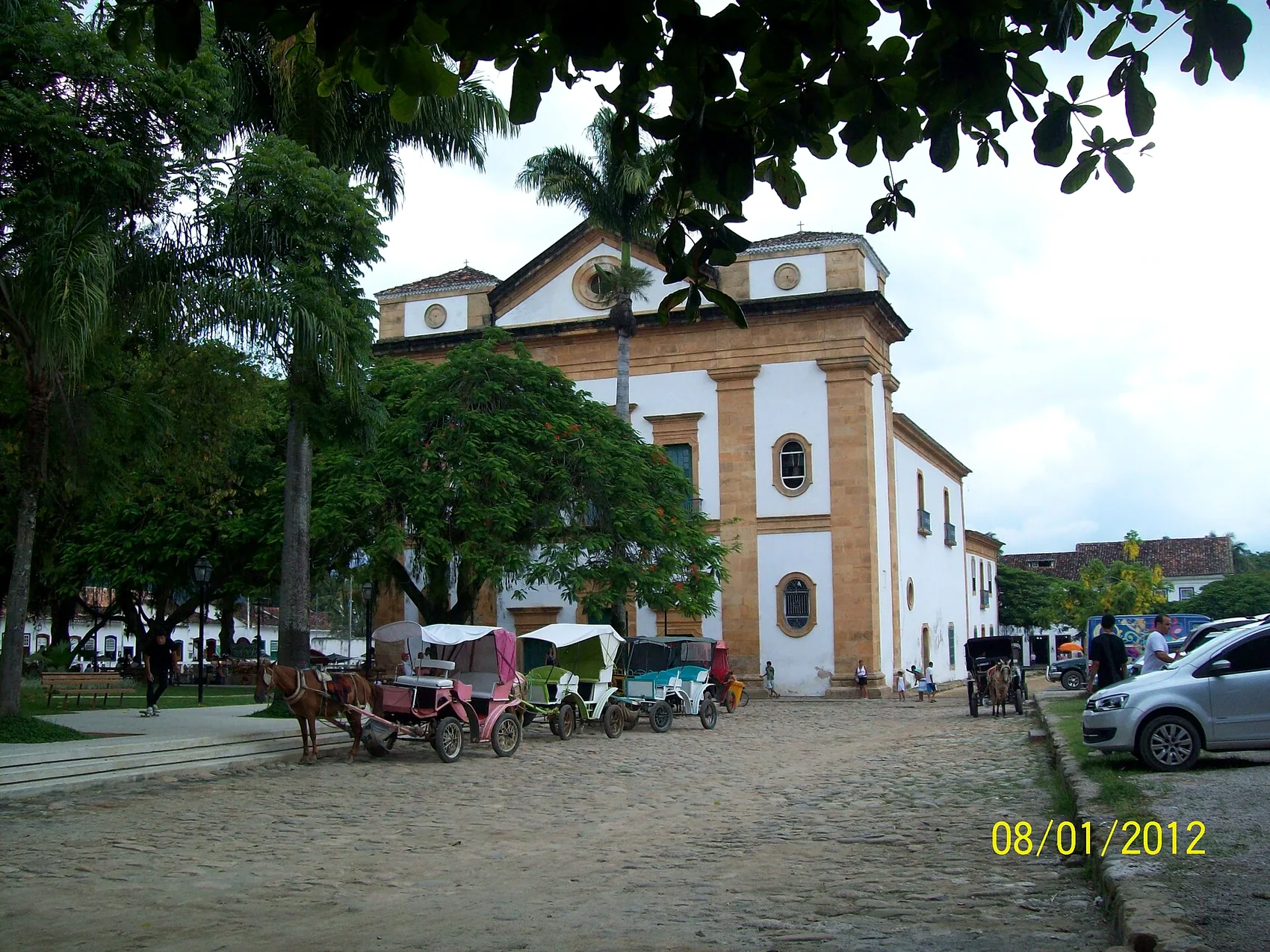
Igreja Matriz de Nossa Senhora dos Remedios — the white townsfolk
On the main square, a couple of blocks back from the water, sits the largest of the four: the Igreja Matriz de Nossa Senhora dos Remedios, the town's mother church and the parish church of Paraty's white population. There has been a church to Our Lady of the Remedies on or near this spot since the town's earliest days; the building you see is a later, grander replacement, begun in the late 1700s when the parish had outgrown the old one, and finished — after repeated stops for lack of money — only in the second half of the 1800s. Local tradition credits much of its completion to a wealthy benefactress, and the unfinished towers are usually explained by the funds simply running out.
It is the most imposing building in town, sober and neoclassical where the older churches are simpler and more baroque, presiding over the square that is still the social heart of the centre. Inside are altars and images carried over from earlier chapels, and an old baptismal font. The Matriz is where the town's official religious life centred — weddings, funerals and the big feast days — and standing on its square, with the smaller churches of the mixed-race and Black brotherhoods a short walk away in different directions, you can read the whole hierarchy of colonial Paraty laid out across a few hundred metres.
Igreja de Nossa Senhora das Dores — the merchant elite
The fourth and smallest, often called the Capelinha — the little chapel — is the Igreja de Nossa Senhora das Dores, tucked near the waterfront on the quieter, northern edge of the centre. It was built around the turn of the 1800s, traditionally at the initiative of the town's elite women, and it became the fashionable, private-feeling chapel of Paraty's wealthiest merchant families during the imperial period. Like the Matriz, it was designed for two towers and got only one.
It is the most intimate of the four, with delicate carved wooden detailing inside, and it sits in one of the prettiest corners of town — a good place to end a church walk, looking back over the rooftops to the sea. When you put the four together, the pattern is unmistakable: the free mixed-race had Santa Rita, the enslaved and free Black community had Rosario, the broad white townsfolk had the Matriz, and the merchant elite had das Dores. Four churches, four social tiers, one small town. There is no better short course in colonial Brazil than walking between them.
The Forte Defensor Perpetuo
For the third dimension of the colonial town, climb out of the grid to the little fort on the headland north of the centre. The Forte Defensor Perpetuo was begun in the early 1700s — its origins are usually dated to 1703 — to guard the harbour and, above all, the gold passing through it from pirates and privateers, who were a real threat to a port shipping treasure. From the hill, the garrison could watch the whole approach to the bay and see hostile sails long before they arrived.
The fort got its grand name — "Perpetual Defender" — in the 1820s, in honour of the emperor Dom Pedro I, and it was rebuilt around then. It was disarmed by the mid-1800s as the threat faded and the town declined, and like so much of Paraty it was later restored as heritage. Today it holds a small museum of local culture and history, but the real reason to walk up is the view: the whole colonial town spread out below, the bay and its islands beyond, and the green wall of the Serra rising behind. It is the best free vantage point in town, and the late-afternoon light over the rooftops from up here is worth timing your walk for.
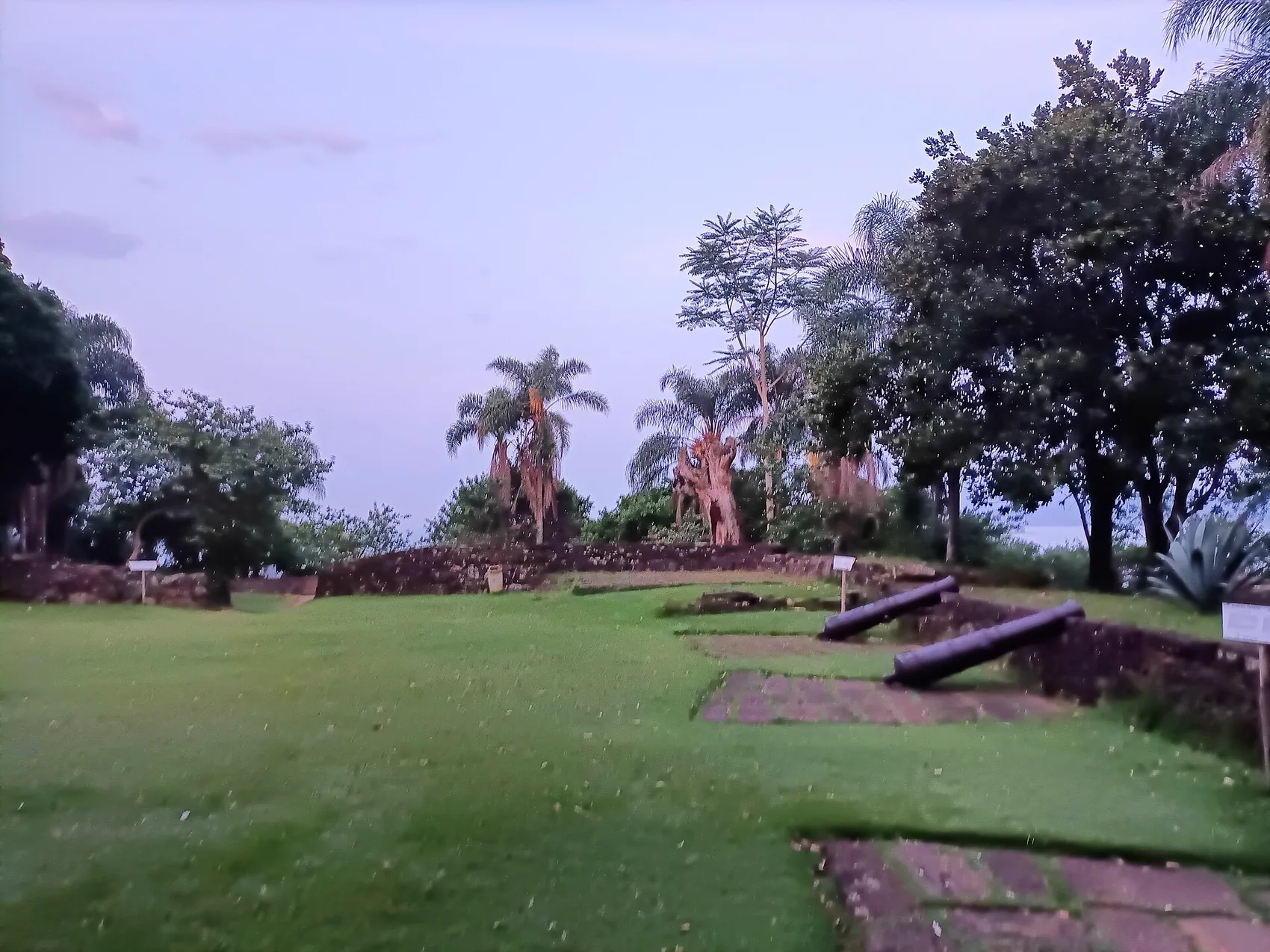
The fort closes the loop on what the colonial town actually was. It's easy, wandering the pretty streets, to forget that this was a working treasure port in a dangerous age — that the gold which built the churches and the merchant houses also drew raiders, and had to be defended. The fort is the muscle behind the beauty. It also pairs naturally with a walk on the surviving stretches of the Caminho do Ouro, the stone gold road that brought that treasure down to this harbour in the first place; together they tell the whole story of why Paraty existed.
Merchant houses, ironwork and the Masonic question
Back down in the grid, the grander two-storey buildings — the old merchant houses — repay a slower look. These belonged to the families who ran the gold and cane-spirit trade, and they show their money quietly: in dressed-stone door surrounds, carved timber, wrought-iron balconies on the upper floor, and sometimes an interior courtyard or atrium that pulled cool air and light into the centre of the house. The ground floor was often warehouse and shop, the family living above — a pattern you can still read in the deep doorways and the position of the windows.
You will also hear, from guides and on plaques, a great deal about Freemasonry in Paraty. The story goes that Masons were powerful among the town's 18th- and 19th-century merchant class, that they left geometric symbols and ciphers carved into facades, that the blue-and-white colour scheme echoes Masonic colours, and that even the town's grid — sometimes said to be thirty-three blocks, after a number sacred to Masons — encodes their influence. Some of this is well grounded: Freemasonry genuinely was a force among the Brazilian elite of the period, and you can see geometric panels and symbols on certain houses if you know to look up.
Other parts of the story — the exact block count, the idea that the whole town was planned as a Masonic diagram, the more dramatic origin tales — are local lore as much as documented fact, and you'll hear bolder and more cautious versions depending on who's telling it. We'd enjoy the symbols and the stories for what they are, take the most sweeping claims with a pinch of salt, and treat a good guided walk as folklore-plus-history rather than gospel. The carved geometry on the facades is real and lovely; how much of it is secret Masonic code is a question with more confident answers than the evidence really supports.
How to read and walk the colonial grid
The historic centre is a rough grid running back from the waterfront, and once you understand its logic it's impossible to get lost. The streets parallel to the water are the main ones; the cross-streets run up from the quay toward the higher ground and the forest. Lower and closer to the sea means older, grander and more flood-prone; higher and further back tends to be a little plainer. The churches sit at the social anchor points, and the square in front of the Matriz is the natural centre of gravity.
Here's the walk we'd actually suggest, give or take your own wandering:
- Start on the waterfront at Santa Rita, early, with the light coming off the water. Note that you're standing at the church of the freed mixed-race community, in the most photographed spot in town.
- Turn into the grid and just walk the parallel streets, letting the whitewash and coloured frames pull you along. Look up for ironwork balconies, carved doors and any geometric facade panels; look down constantly, because the cobbles will trip you if you don't.
- Find the main square and the Matriz, the white townsfolk's church and the official heart of town. Pause here; it's the best people-watching in the centre.
- Detour to Rosario, the plain church of the enslaved and free Black community, and let the contrast with the Matriz land.
- Loop back toward the water to das Dores, the elite women's little chapel, in its quiet corner.
- Climb to the fort for the overview — ideally late afternoon — and watch the whole town you've just walked lay itself out below you.
Do that loop slowly, with a long lunch dropped in the middle, and you've understood Paraty's colonial centre better than most visitors ever do. If a grey sky moves in, none of this is spoiled — the town and its churches handle rain beautifully, and a wet morning in the centre is one of our favourite recommendations on our rainy-day guide.
Practical notes for visiting the historic centre
- Shoes. We can't say it often enough. Flat, grippy, closed shoes for the cobbles. Save the sandals for the beach.
- Timing. Early morning for quiet and light; evening for lanterns and atmosphere; a big spring tide if you want the mirror streets. Midday is the hottest and busiest.
- Church etiquette. Modest dress, quiet voices, no flash, no photos during services. Hours are short and shift with the season — confirm them locally on the day.
- Accessibility. The cobbles are hard going for wheelchairs, strollers and unsteady walkers. The town is doable with care and time, but go slowly and pick the smoother margins of the streets.
- Respect that people live here. Many of these houses are private homes, not exhibits. Photograph the streets freely, but don't lean into doorways or windows.
- Cash. Cards work in most shops and restaurants, but the small museums, kiosks and a few church donation boxes appreciate a little cash in reais.
If you want to fold the colonial centre into a wider plan, our ultimate guide to Paraty shows where it fits alongside the bay, the beaches and the forest, and the resources page gathers the maps and practical downloads. When you're ready to talk dates, or just want us to tell you when the next big tide falls during your stay, get in touch — pointing guests at the right morning for the streets is one of our favourite small jobs.
The last word
Paraty's historic centre looks, at first glance, like a charming colour-saturated set. Spend a slow morning in it and it becomes something much richer: a complete colonial town where the houses, the stones, the tides and the four churches still tell you exactly who lived here, who worked here, who was free and who was not, and what it took to defend a treasure port three centuries ago. Almost nothing in it is accidental, and almost nothing has been faked back into place — it survived because the world forgot it, and it endures because the people who rediscovered it chose to keep it whole.
From up on the ridge we watch the light move across those rooftops every evening, and the town never stops being worth the walk down. Read it once, the way we've laid it out here, and you'll carry the whole story of the place in your feet — every uneven, ballast-stone, sea-washed metre of it.
Come stay above the bay
Chalé Bel Air sits on the ridge that looks over everything in this guide. Tell us your dates and what kind of trip you are after — we answer personally.
Ask about your datesFrequently asked questions
What is the oldest church in Paraty?
The little Igreja de Santa Rita, on the waterfront, is generally cited as the oldest surviving church in the historic centre, with a founding usually given as 1722. It was built by and for Paraty's free mixed-race Catholics, and today it holds the town's museum of sacred art. The architect Lucio Costa called it the finest building in Paraty.
Why do Paraty's streets flood?
It is by design, not by accident. The lowest streets near the water were laid so that the highest spring tides — usually around the full and new moon — slide in through gaps in the seawalls, wash the cobbles clean, and drain away again as the tide drops. The water is normally only ankle- to shin-deep and clears within an hour or two.
Why are Paraty's cobblestones so uneven?
They are pe-de-moleque stones — large, irregular blocks laid by hand without mortar, deliberately domed in the middle so water runs to the sides. Many arrived as ship's ballast and were set into the streets by enslaved labour. The surface is beautiful and genuinely hard to walk on, so flat, grippy shoes matter more here than almost anywhere.
Can you go inside Paraty's churches?
Usually yes, though hours are short and irregular and some open mainly around Mass or for the small museum inside Santa Rita. Treat the four historic churches as places of worship first: dress modestly, keep your voice down, and check current opening times locally, since they change with the season and with restoration work.
How long do you need to see Paraty's historic centre?
The colonial grid is only a few hundred metres across, so you can walk every street in a couple of hours. To actually take it in — the four churches, the fort, the merchant houses and the tides — give it a slow half-day, ideally a clear early morning before the day-trip groups arrive.
.jpg)
.jpg)


