Down a steep road at the far southern edge of the municipality sits Trindade, a caiçara surf village of five beaches and one exceptional natural pool — the wildest, most relaxed day out you can have from Paraty without a boat.
There is a moment, about two-thirds of the way down the road to Trindade, where the forest opens and you see the whole thing at once: a curve of white sand, a river of surf coming in off the open Atlantic, and a village of low houses scattered under the palms at the foot of a green wall of mountain. It looks like the coast used to look before anyone built anything, and to a large extent that is exactly what it is. Trindade Paraty — the surf village at the far southern edge of the municipality — is the place local families and travellers alike go when they want the wild version of this coastline rather than the polished one.
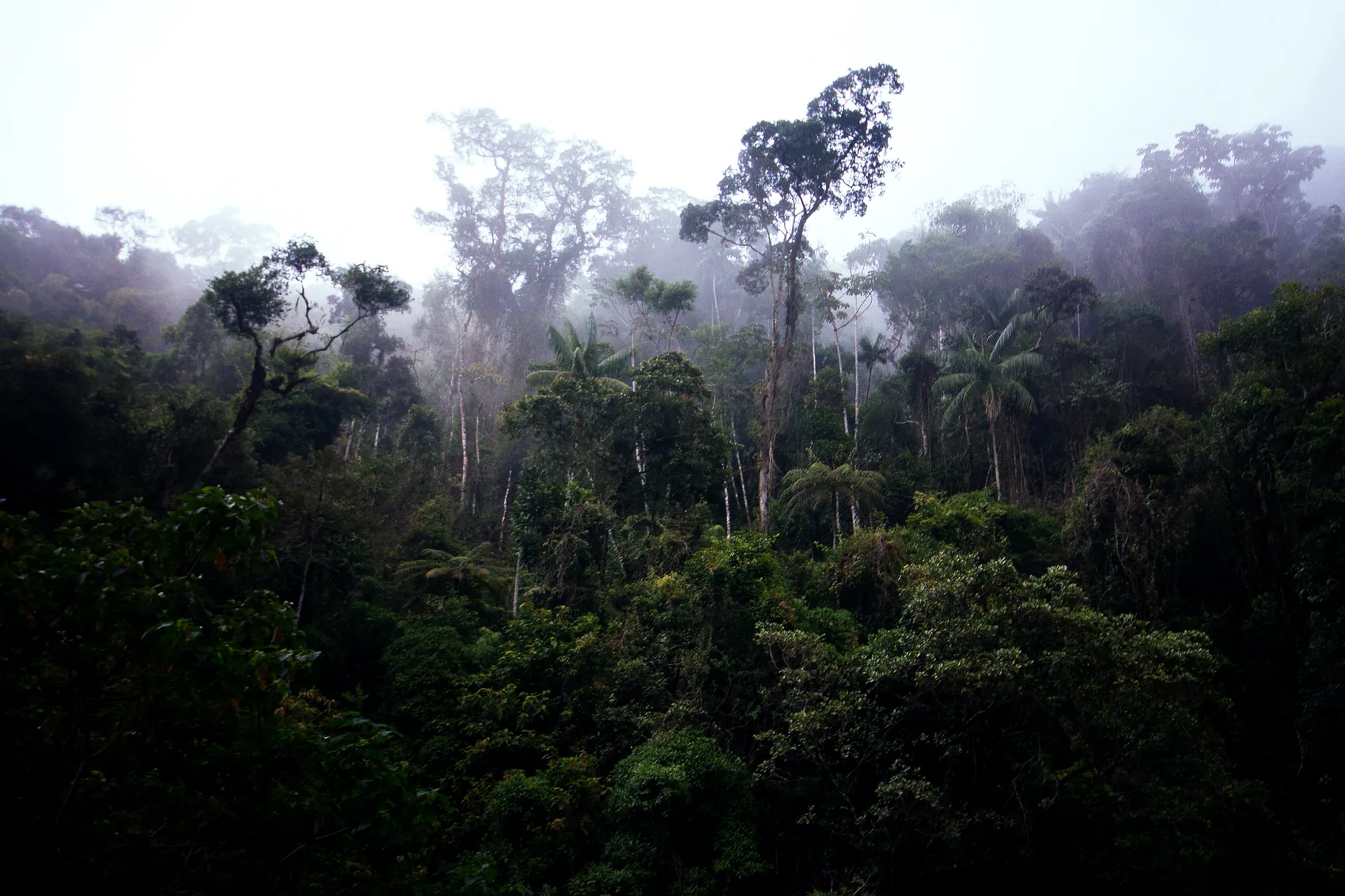
Trindade sits inside the Serra da Bocaina National Park, which is the single most important fact about it. The park is why the mountains behind the village are still solid rainforest, why the road stops where it stops, and why nobody built a marina or a chain hotel here. What you get instead is five distinct beaches strung along a few kilometres of coast, a natural swimming pool enclosed by granite boulders, a handful of simple pousadas and seafood kitchens, and a barefoot, unhurried rhythm that has survived remarkably intact. It is not luxurious. It is something rarer, which is genuinely undeveloped, and that is precisely the point.
This guide covers what you actually need: how to get there and how long it really takes, the character of each beach and which one suits you, how to find the Cachadaço natural pool, what the village is like and where its calm came from, whether to go for a day or stay the night, and the honest trade-offs either way. We send guests to Trindade often. It is the one day out from a Paraty stay that reliably becomes the story people tell when they get home.
Where Trindade sits, and why it feels different
Paraty's coastline breaks roughly into two moods. North and east of town lies the calm, island-studded Bay of Paraty, all flat green water and schooner stops — the part you see from the deck at the chalé, and the part most day-boats explore. Trindade is the opposite temperament. It faces the open ocean at the southern end of the municipality, hard against the border with São Paulo state, and the sea here has fetch and force behind it. The result is real surf on some beaches, calm coves on others, and water that ranges from bathtub-still in the natural pool to genuinely powerful on the surf breaks a few hundred metres away.
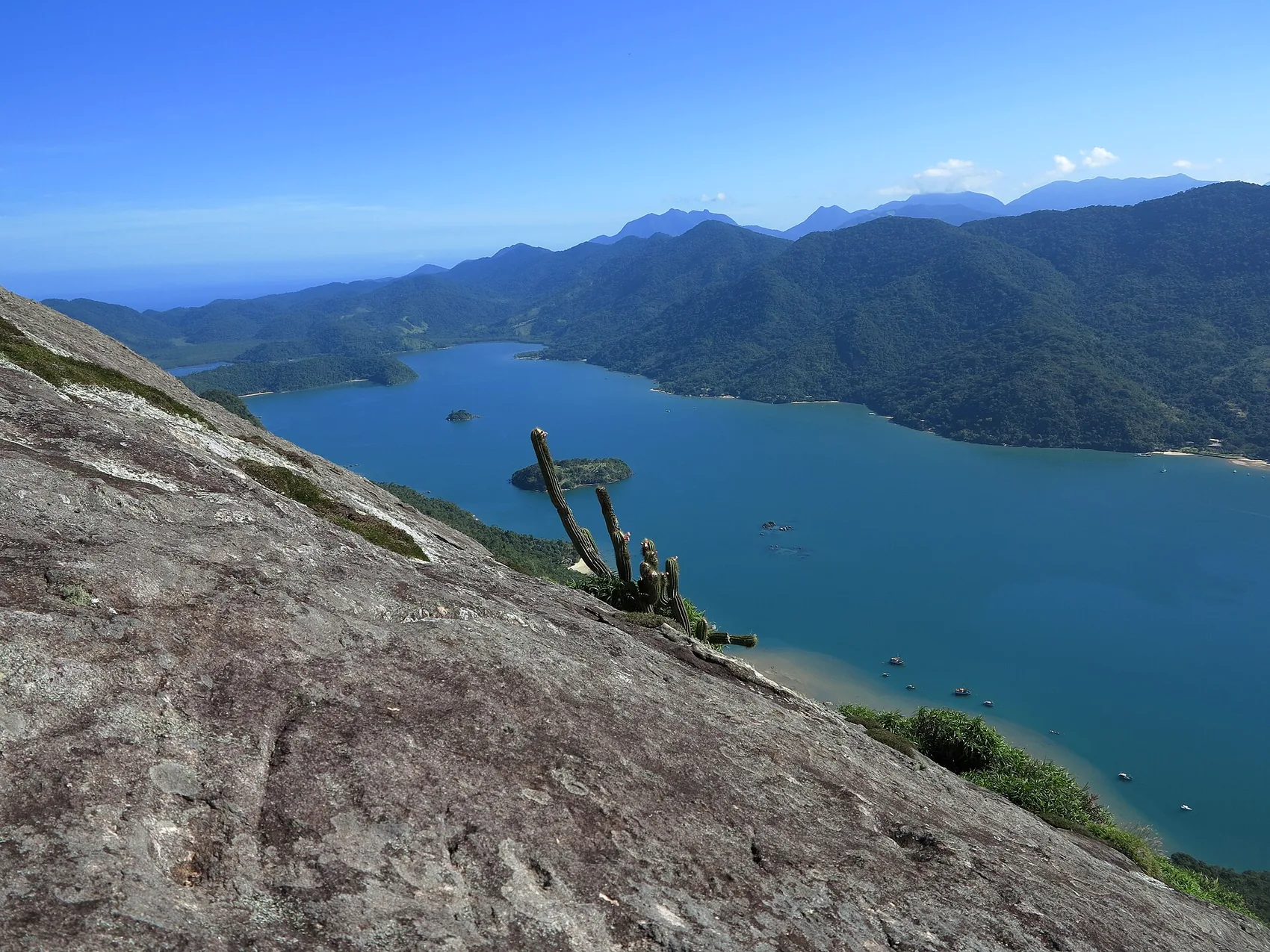
The geography is dramatic because the Serra do Mar mountains fall almost straight into the sea here. The village occupies a narrow shelf of flat land between the wall of the Serra da Bocaina and the beaches, which is why the road down is so steep and why the whole place feels tucked under the forest. Officially, part of Trindade lies within the Serra da Bocaina National Park and part within a locally protected area established in the 1980s. In practice, this means the surrounding hills cannot be built on, the beaches at the ends of the village are reached only on foot or by boat, and the Atlantic Forest comes right down to the sand.
All of this is why Trindade feels different from the bay side of Paraty, and why it rewards a slightly different mindset. You are not coming for infrastructure. You are coming for the specific pleasure of a coastline that looks after itself.
Getting to Trindade from Paraty
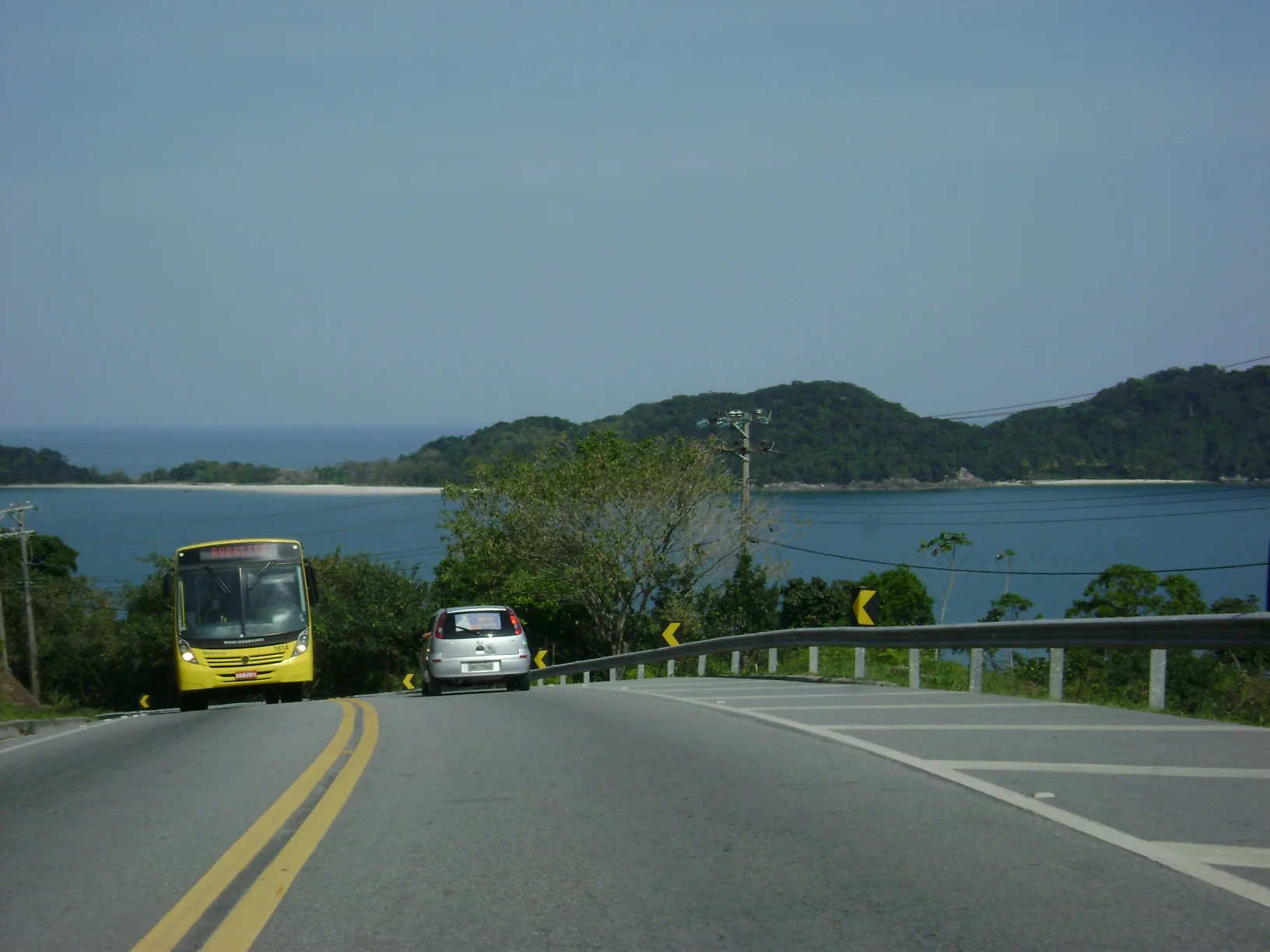
Trindade is close in kilometres and slow in minutes, which is worth understanding before you set out. It lies about twenty-five kilometres south of central Paraty, but the last stretch is a steep mountain descent, so the drive takes longer than the distance suggests. From most bases near town, plan on roughly forty minutes each way. From a hillside spot above Paraty like the chalé, add a few minutes for the climb down to the main road first.
By car
Driving is the easiest way, and it gives you the freedom to leave when you like — useful, because the best light and the emptiest sand come early and late. Take the BR-101, the coastal Rio-Santos highway, south out of Paraty. After about half an hour you reach the small roadside settlement of Patrimônio, where a well-signposted road turns off and drops down to Trindade. That final road is narrow, winding and steep, with sharp bends and a real gradient. It is perfectly manageable in a normal car driven with care, but if you are nervous about mountain roads or driving an unfamiliar rental, go slowly, use a low gear on the way down to save your brakes, and do not attempt it in the dark after a few caipirinhas.
A note on parking: you cannot drive into the heart of the old village. Cars stop at lots and roadside spaces at the entrance, where attendants charge a flat daily fee — cash, of course — and from there everything is on foot. This is a feature, not a bug. The car-free core is a large part of why Trindade feels the way it does.
By bus and other options
If you would rather not drive, municipal buses run from the Paraty bus terminal to Trindade several times a day. The fare is small and the trip takes around fifty minutes, winding down the same mountain road. Buses are the local way to go and perfectly reliable, but they run to a timetable, so check the return times before you commit to the last beach of the day. Taxis and rideshare from Paraty are available too and are the least stressful choice if you want the door-to-door convenience of a car without driving the descent yourself; agree the fare and, ideally, a pickup time in advance, since signal in the village is unreliable for calling one back.
For a fuller picture of transport across the region — buses, taxis, car hire and boats — our getting-around guide lays out the options and the realistic costs.
If you are coming from further afield
Most people reach Trindade as part of a Paraty trip rather than as a destination in itself, and where you started shapes the day. Visitors driving down from São Paulo often pass close to this end of the coast on the way in — Trindade is on the São Paulo side of Paraty — so it can make sense as a first or last stop rather than a there-and-back detour. Travellers coming from Rio de Janeiro arrive from the opposite direction and cross the whole town to reach it, which is one more reason to treat Trindade as a full day rather than a quick morning. And for anyone arriving from abroad, usually via Rio or São Paulo and then the coastal road, the thing to internalise is that Brazil's distances hide behind winding mountain roads: Trindade is not far, but nothing here is quick, and that unhurried pace is the whole holiday.
The village, and where its calm came from
Trindade was, and to a real degree still is, a caiçara village — the caiçara being the traditional coastal communities of southeastern Brazil, descended from Indigenous, Portuguese and African roots, who lived for generations by fishing, small-scale farming and canoe-building. For most of its history this was a remote fishing settlement reachable mainly by sea, and that isolation is why so much of its character survived.
The modern story of Trindade is genuinely good, and worth knowing as you walk through it. In the 1970s, after the coastal highway opened the region up, developers set their sights on this stretch of coast, and at one point a company tried to move residents off their land to build a resort. The community organised, drew in support from well-known Brazilian artists and musicians, and won enough public attention that the plans collapsed. Around the same time, Trindade became a refuge for a countercultural, bohemian crowd drawn by the cheap living and the scenery. The two threads — a fishing village that held its ground and a hippie hideaway that never quite left — are still legible in the place today: barefoot, informal, a little scruffy in the way that authentic places usually are, and completely unbothered by the idea of impressing you.
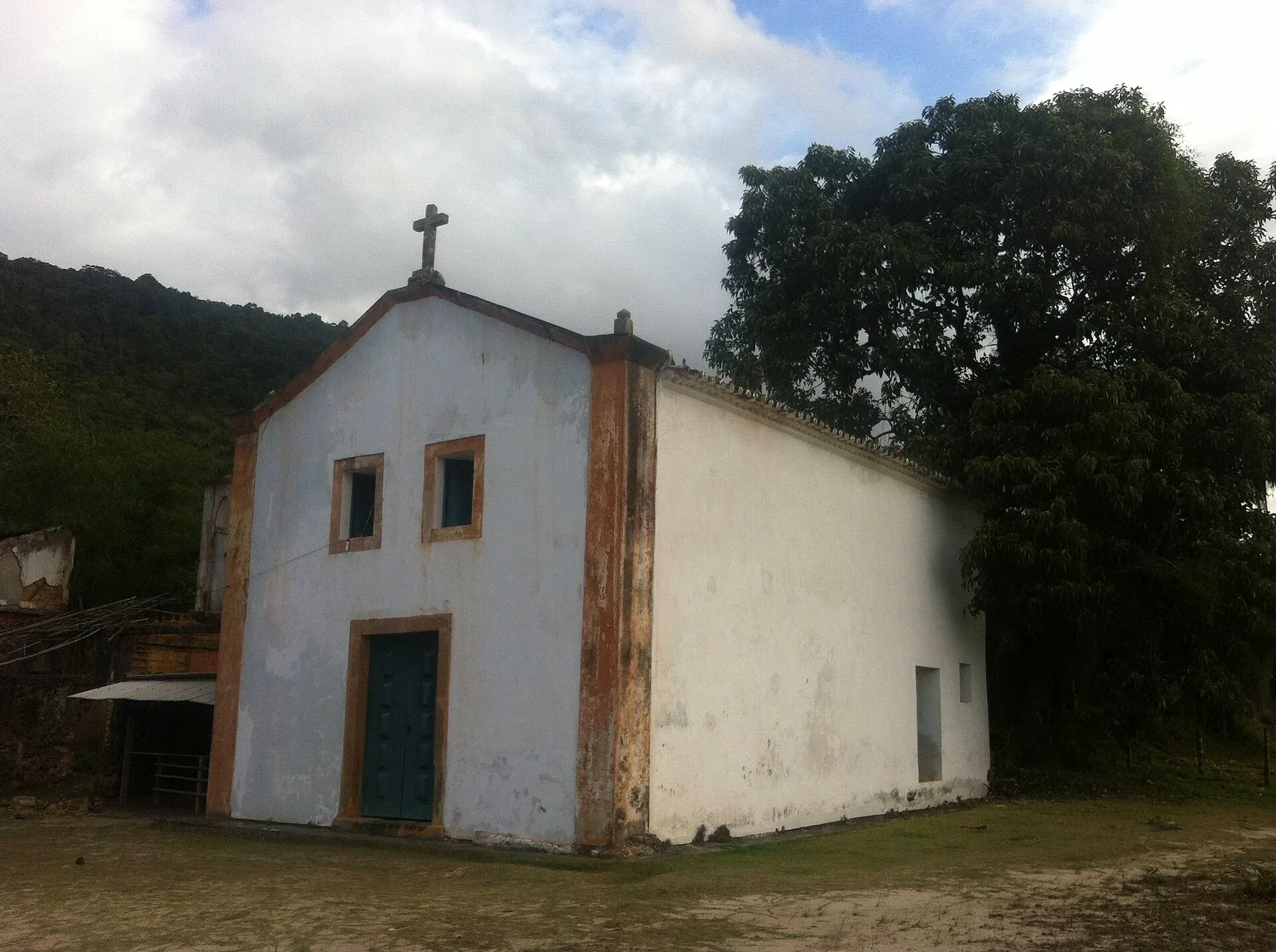
What the village actually contains is modest and part of the charm. A single main street and a few sandy lanes run back from the beach, lined with simple pousadas, family restaurants, kiosks, surf-board rentals, a small church, and shops selling swimwear, açaí and cold drinks. There is no bank of note, patchy phone signal, and nothing you would call nightlife beyond a beachside beer and live music on a busy weekend. For a livelier evening you go back to Paraty's bars. Trindade's currency is daylight and saltwater.
Trindade trades comfort and infrastructure for scenery and calm — and it is entirely unbothered by the idea of impressing you.
The beaches, one by one
Trindade's five beaches are strung west to east along the coast, and they are genuinely different from one another — which is the single most useful thing to grasp before you arrive. Choosing the wrong one for your group is the main way people come away underwhelmed. Here they are in the order you meet them coming down the road, with what each is actually good for.
Praia do Cepilho — the surf beach
Cepilho is the first beach you reach arriving in Trindade, and it announces the mood of the place: open, exposed, and often loud with surf. A sandbar here can produce fast, powerful, hollow waves, which makes it the address for surfers and bodyboarders and a poor choice for a relaxed family paddle. The current can be strong and the shorebreak dumps hard on a big day. It is a wonderful beach to sit on and watch the ocean do its thing, and if you surf, this is your reason to come. If you have small children or weak swimmers, admire it and move along to calmer sand.
Praia Brava — the walk-in surf cove
Beyond Cepilho, reached by a short forest trail over the headland, lies Praia Brava — the name literally means "wild beach," and it earns it. This is another surf-facing cove, more secluded because you have to walk to it, backed by dense Atlantic Forest with no kiosks or services. The reward for the twenty-minute walk is a beautiful, often near-empty beach with serious waves; the price is that you carry in everything you need and the sea is not for casual bathing. Wear proper shoes for the trail, take water, and treat it as a small adventure rather than a lounging spot.
Praia dos Ranchos and Praia do Meio — the village beaches
These are the two you want if you are here to swim, dig in with a family, or simply do very little. Praia dos Ranchos — sometimes called Praia de Fora — is the main beach in front of the village, the biggest and most sociable, lined with kiosks grilling fish and pouring cold beer, with fishing boats pulled up on the sand and calmer, more forgiving water than the surf beaches. Praia do Meio, the next cove along, is smaller and quieter, reached by a short walk, and edges toward the calm that reaches its peak at Cachadaço. Together these are the heart of a Trindade day: shade, snacks, easy swimming, and the village a few steps behind you. Families with young children should base themselves here. Our Paraty with kids guide has more on which beaches around the region suit small legs.
Praia do Cachadaço — the gateway to the pool
At the far eastern end of the village, a well-trodden trail of fifteen to twenty minutes through the forest leads to Praia do Cachadaço, a smaller, exceptionally pretty beach with clear water and a backdrop of huge rounded boulders. It is lovely in its own right and calmer than the surf beaches, but its main role is as the doorway to the natural pool just beyond it, which deserves a section of its own.
The Cachadaço natural pool
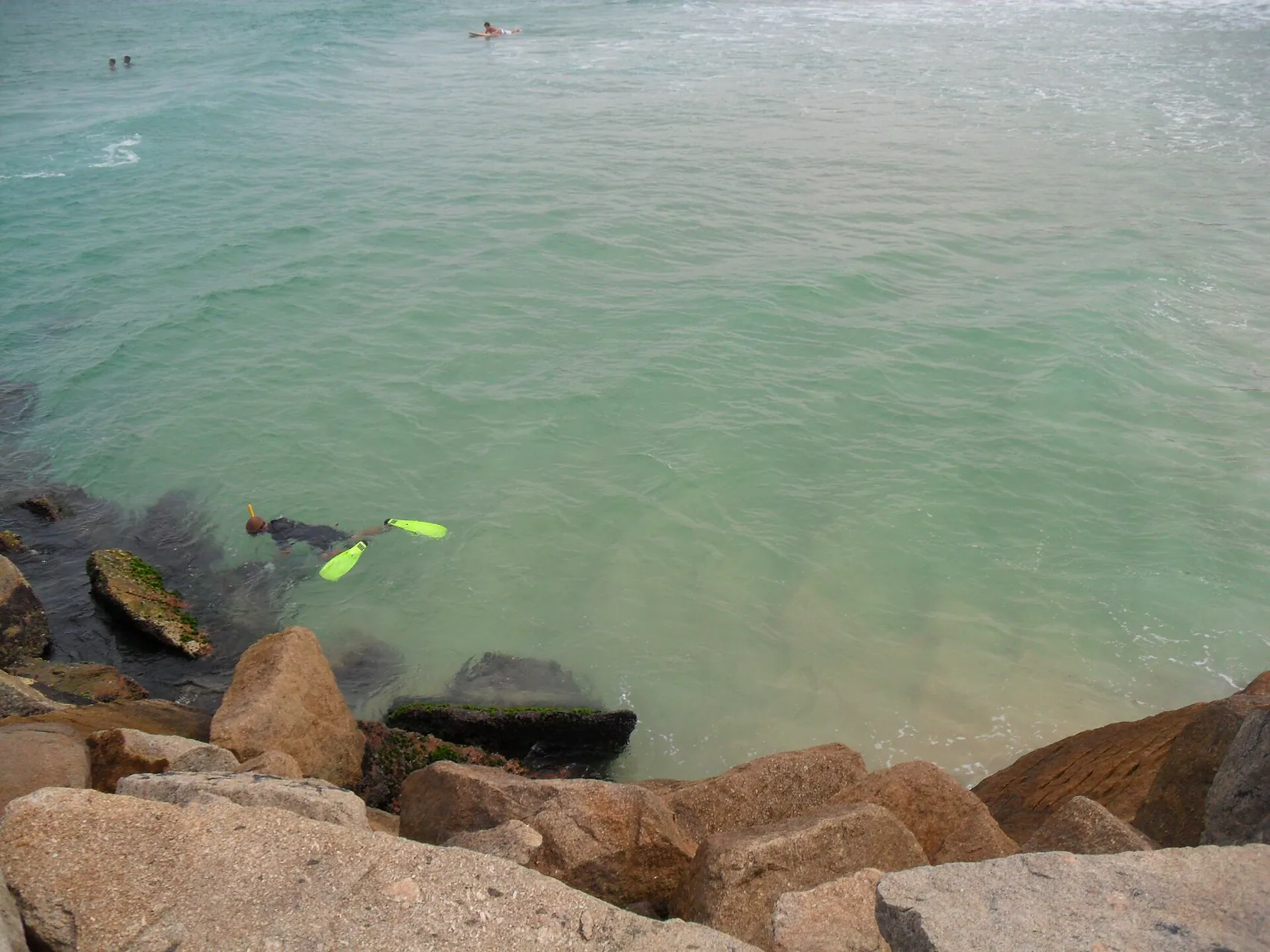
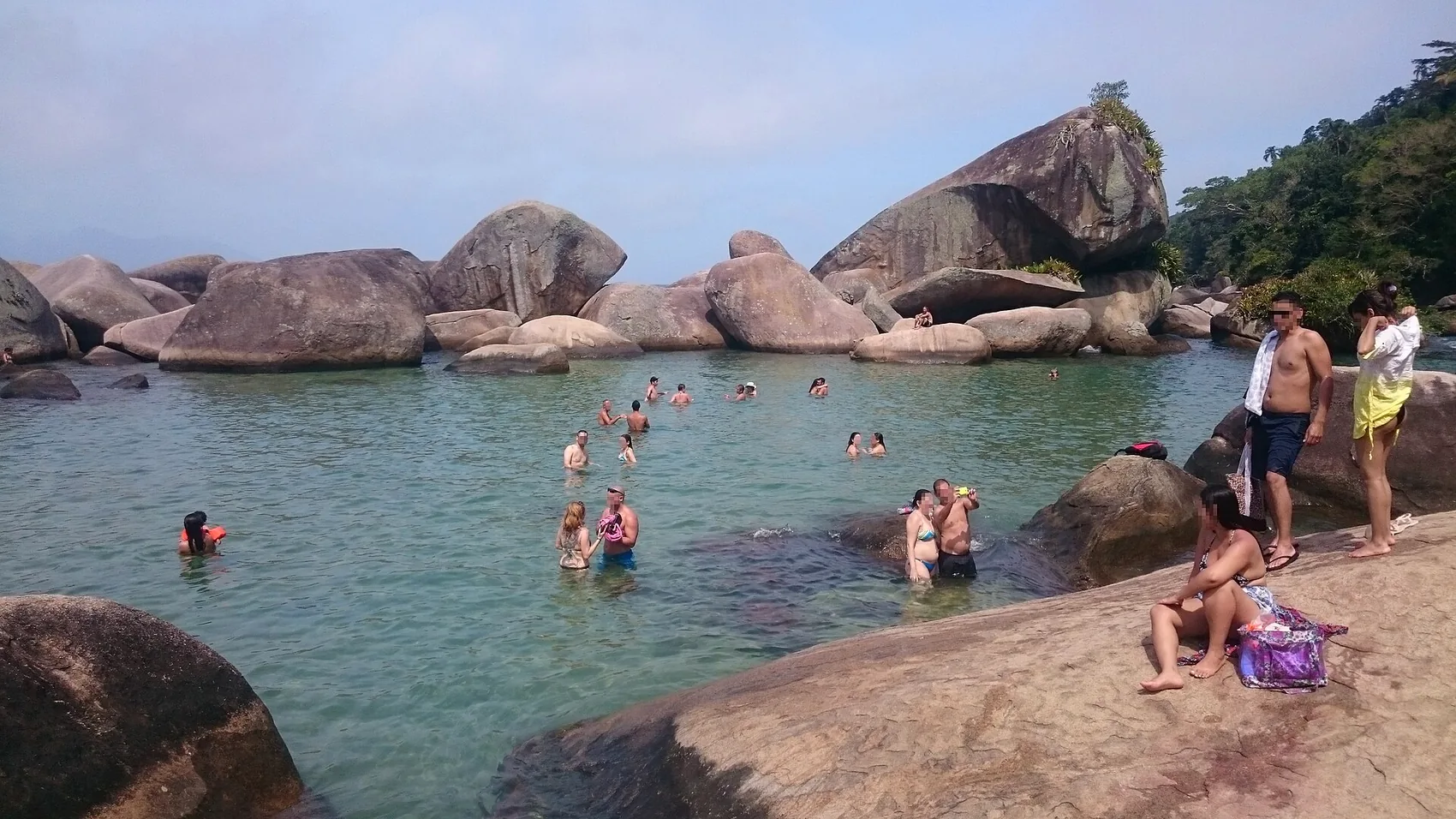
The Piscina Natural do Cachadaço is the reason a lot of people make the trip, and it lives up to it. At the eastern tip of Trindade's coast, a cluster of enormous granite boulders sits just off the shore, and between them and the beach the rocks enclose a basin of seawater that the swell cannot reach. The effect is a natural swimming pool — clear, calm, waist-to-chest deep in the sheltered parts — with a sandy and rocky bottom and shoals of small tropical fish that will happily circle your legs. On a bright day the water is a pale, luminous green, and you can see straight to the bottom.
This is the best easy snorkelling near Paraty. You do not need a boat, a guide or any skill: bring a cheap mask and you will see fish immediately. The rocks give the pool its calm and also its hazards, so the usual sea-cave sense applies — the enclosed side is placid, but do not swim out past the boulders into the open swell, and mind the sharp rock and any surge on a bigger day. For more ambitious underwater days around the region, our snorkelling and diving guide covers where the clear water and the reef fish concentrate.
How to reach the pool
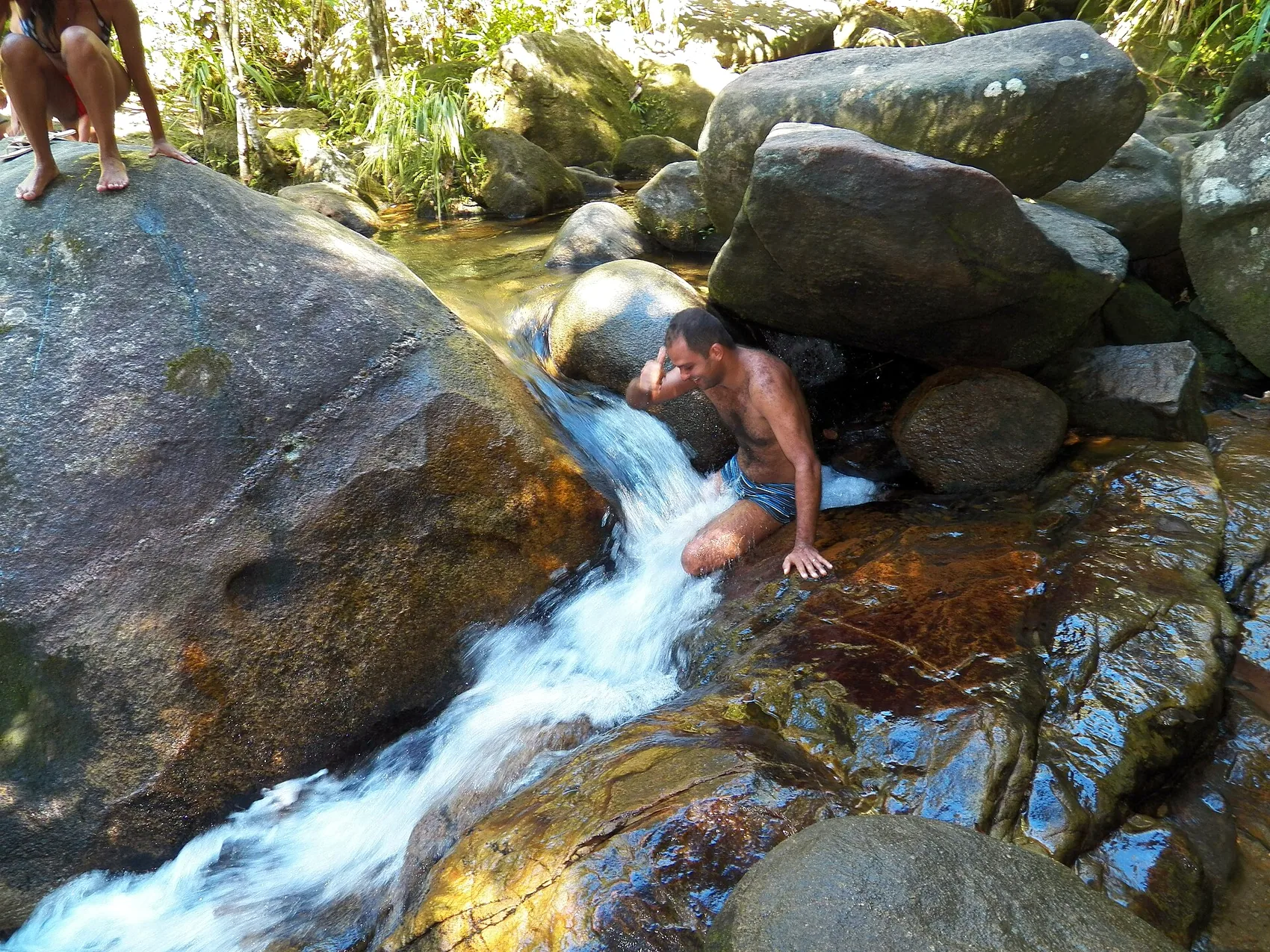
There are two ways in, and they suit different people. The trail is the classic route: from the eastern end of the village you walk a forest path — roughly forty-five minutes to an hour all in, the last part scrambling over and among the boulders at Cachadaço. It is not a hard hike, but it is uneven, rooty and rocky in places, so you want real shoes rather than flip-flops, and you should skip the scramble if the rocks are wet and slick after rain. The walk itself is a pleasure, all filtered green light and glimpses of the sea. Our hiking guide puts this in context with the region's other trails.
The boat is the shortcut. Small local boats run from the village beach around to Cachadaço and the pool for a modest fee — the easiest option if you have young children, limited mobility, or simply want to save your energy for swimming. Boatmen work on cash and informal timing, so agree the price and a rough pickup before you climb in. Many people walk one way and take the boat back, which is a sensible plan.
Timing the pool
The natural pool is small and famous, which is a combination that means crowds at the wrong hours. On summer weekends and holiday weeks it can get genuinely busy by late morning, with a queue building on the boulder scramble. The fix is the same as everywhere on this coast: go early. Aim to be walking the trail by nine, and you will often have the pool close to yourself before the day-trippers arrive, with the added bonus of gentler sun for snorkelling. Late afternoon empties out again as people start the drive home. The middle of the day, especially in January and February, is the crowd.
Pool-day kit: a mask, water shoes or grippy sandals for the boulders, drinking water, reef-safe sunscreen and a dry bag for phones and cash. There are no shops at the pool itself, so carry in what you need and carry every scrap of it back out.
Surfing, and playing in the waves
Trindade is one of the better-known surf spots on the Costa Verde, and if you ride, it is a real draw rather than a novelty. Praia do Cepilho is the main event, a beach break with a sandbar that on the right swell produces fast, hollow, short-ride waves that reward experienced surfers. Praia Brava, over the headland, catches swell too and offers a wilder, less crowded session for those willing to walk. Boards can be rented in the village, and there is a small, friendly local surf scene.
For everyone else, a word of caution and a word of encouragement. The caution: the same energy that makes the surf good makes Cepilho and Brava unsuitable for casual swimming, especially with children — the shorebreak and currents are real, and there are no lifeguard towers to lean on. The encouragement: you do not need to surf to enjoy the ocean here. The village beaches give you gentle water to splash in, the natural pool gives you calm to snorkel, and the surf beaches give you a spectacular free show. Beginners who want a lesson are better off arranging one on calmer sand and treating Cepilho as aspirational.
Eating and drinking in Trindade
Trindade eats simply and eats well, and it is fair to set expectations: this is grilled fish and cold beer under a thatched roof, not a tasting menu. The kiosks strung along Praia dos Ranchos are the heart of it — you sit at plastic tables with your feet more or less in the sand and order whatever came in that morning. The seafood houses toward the harbour end of the village do the same on a slightly larger scale, plus the regional staples.
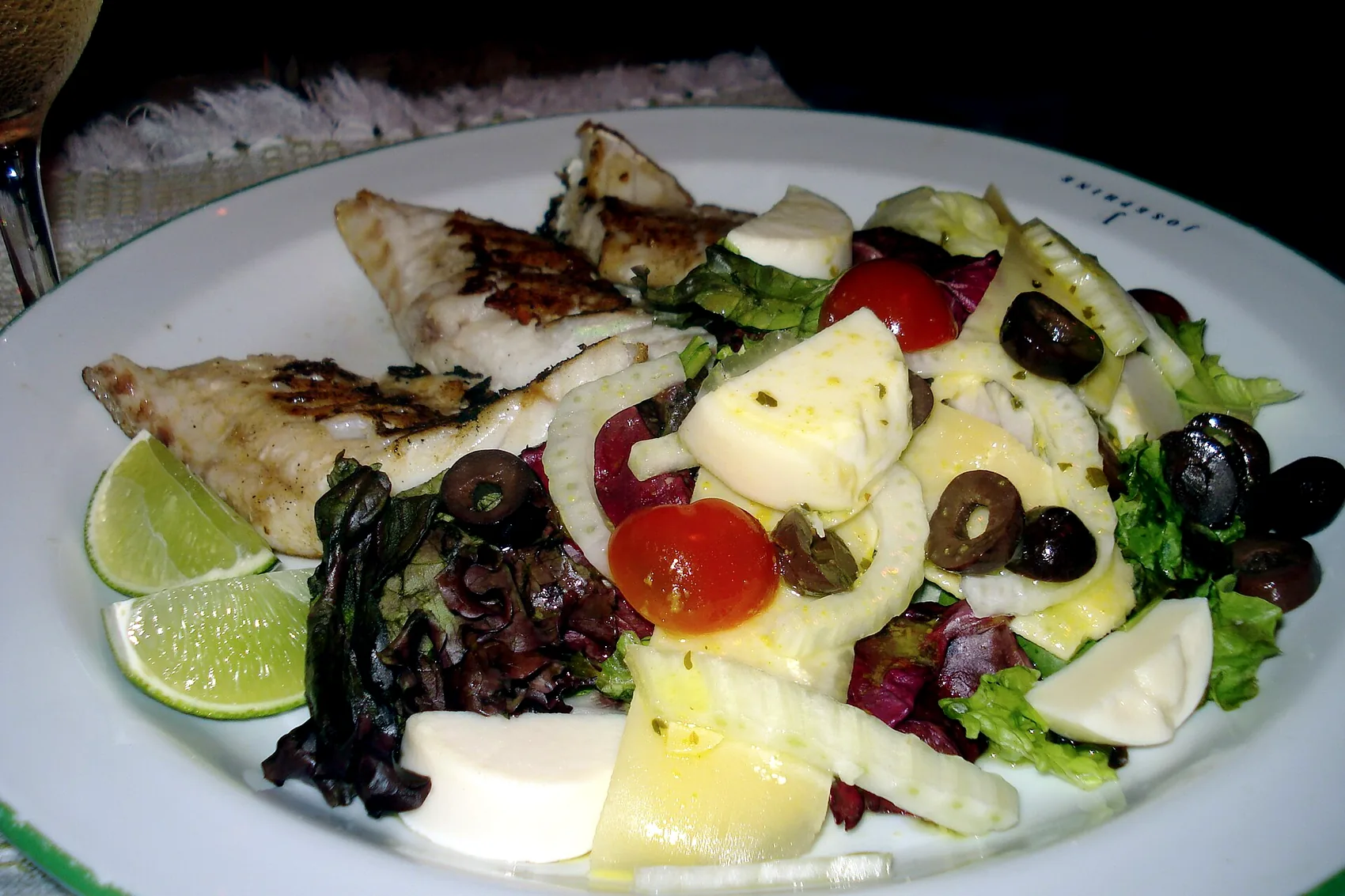
What to order? The obvious answer is fresh fish — grilled whole, or filleted, usually served with rice, beans, farofa and a simple salad, generous enough to share. A seafood moqueca, the coconut-and-palm-oil stew of the Brazilian coast, is the thing to have if you want one proper sit-down meal, though it takes time to make, so order it and then go for a swim. Prawns done in garlic, fried fish pastéis from a beach kiosk, açaí bowls, coconut water straight from the shell, and a caipirinha at sunset round out the menu of a good Trindade day. Prices are fair for what it is, cash is king, and nobody is in a hurry — which, once you accept it, is exactly right. If you want to plan a more ambitious food day back in town, our where to eat in Paraty guide covers the fuller range.
What to bring, and what to expect
Trindade rewards a little preparation, mostly because it deliberately lacks the conveniences you might assume. A few honest practicalities:
- Cash. There is no reliable banking in the village and card acceptance and signal are patchy, so bring enough reais for parking, food, kiosks, boat rides and a margin. Draw it in Paraty before you leave.
- Real shoes. The trails to Cachadaço, Brava and the natural pool are rooty and rocky. Flip-flops will do for the sand, but bring closed or grippy shoes for the walking, and water shoes help on the boulders.
- Sun protection. The equatorial sun is stronger than it feels off the ocean breeze. Reef-safe sunscreen, a hat and a rash top for long snorkelling sessions all earn their place — and reef-safe matters here, since you are swimming in a protected area.
- Water and snacks. There are kiosks on the main beaches, but nothing at the far beaches or the pool. Carry water, and carry your rubbish out.
- A dry bag. For phones, keys and cash while you swim, and for keeping sand out of the important things.
- An early start. The best of Trindade — the empty pool, the parking, the clear light — belongs to people who arrive before ten.
Our full what to pack for Paraty guide goes deeper on the whole trip, but for a Trindade day, the list above is most of the battle.
Day trip or stay the night? The honest answer
This is the question guests ask most, so here is the straight version. The great majority of visitors do Trindade as a day trip, and for most people that is the right call. A day gives you time to do two or three beaches and the natural pool, eat a long lunch of grilled fish, and drive back before dark — a full, satisfying day out that slots neatly into a Paraty stay. You get the best of the place without committing to its limitations after hours.
Staying overnight has a real appeal for a certain traveller. The prize is the early morning: the beaches and the natural pool at their emptiest and most luminous, before the day's cars arrive, and a slow surf-village evening with your feet in the sand. The trade-offs are honest ones. Trindade's pousadas are simple and small, sophisticated dining and services are thin, the signal is patchy, and on peak summer weekends the village fills up and the calm you came for gets diluted. If you are a surfer chasing dawn sessions, or a couple who genuinely wants to unplug in a rustic place, a night or two can be lovely. If you want comfort, a proper bed, a pool of your own to come back to and dinner options, you will be happier basing yourself near Paraty and treating Trindade as the wild day out.
That second pattern is the one we see work best. You spend your day among Trindade's beaches, then drive back up to a base with the comforts the village doesn't have — which, for our guests, means the short climb to a hillside chalet with an infinity pool and its triple view over the Bay of Paraty, Angra dos Reis and Ilha Grande. After a day of salt, surf and boulder-scrambling, there is a lot to be said for a hot shower and a quiet swim with the whole coast laid out below you, and no drive to anywhere. The luxury rentals guide weighs the different ways to base a Paraty trip.
Who Trindade suits — and who it doesn't
Part of giving good advice is being honest about fit, so here is who tends to love Trindade and who tends to leave grumbling.
Couples and friends who want a wild, scenic, low-key beach day — with the option of a surf, a snorkel and a long lunch — are the natural fit. Surfers have an obvious reason to come. Families do well provided they base themselves on the calm village beaches and treat the surf breaks as scenery; the natural pool, reachable by boat, is a genuine hit with children old enough to snorkel. Solo travellers find it friendly and easy, especially the backpacker-inflected corners left over from its bohemian era.
Who should think twice? Anyone who defines a good beach day by beach clubs, sun-lounger service, valet parking and cocktail lists will find Trindade's rustic honesty frustrating rather than charming. People with serious mobility limitations should know that the best beaches and the pool involve walking, boulders and boat transfers, though the main village beach is reachable and lovely on its own. And anyone allergic to a winding mountain road should let someone else drive. None of this is a knock on the place. It is simply a village that is exactly itself, and the more you meet it on its own terms, the better it is.
When to go, and reading the crowds
Trindade's rhythm follows the same seasonal beat as the rest of the coast, amplified by the fact that it is small. The Brazilian summer, from December through February, brings the warmest sea, the longest days and by some margin the biggest crowds — Trindade on a January weekend or over Carnival and New Year is a busy, festive, and occasionally overwhelmed place, with the parking full and the natural pool shoulder to shoulder by midday. It is still worth it if you arrive early, but go in with realistic expectations.
The sweet spots are the shoulder seasons. March to May and August to November keep the water warm enough and thin the crowds dramatically, and a weekday in these months is close to how Trindade must have felt decades ago. Winter, June and July, is cooler and can be rainy, but the swell is often good and the village is at its most peaceful; pack a light layer for the evening. Whatever the month, the two reliable levers are the same everywhere here: choose weekdays over weekends, and mornings over afternoons. Our best time to visit Paraty guide breaks the seasons down in full.
Visiting responsibly
It bears repeating, because it is the whole reason Trindade is worth the drive: this is a living caiçara community inside a national park, not a resort built to absorb you. The community fought for this coast and won, and the park protects the forest that makes it beautiful. A few small habits keep it that way. Carry out everything you carry in — there is no infrastructure at the far beaches to deal with your rubbish. Use reef-safe sunscreen, since you are swimming in protected water full of fish. Don't stand on, break or take the corals and rocks, and don't feed the fish in the pool. Spend your money with the local kiosks, boatmen and pousadas rather than treating the village as a backdrop. And be a considerate guest in a place where people actually live — the same courtesy you would want extended to your own street.
Trindade has survived precisely because enough people, residents and visitors alike, treated it as worth protecting. Being one of those people costs nothing and is part of the pleasure.
One-line plan: leave your base by nine, drive the BR-101 to the Patrimônio turn-off and down to Trindade, park at the entrance, walk to the village beach, then take the trail or a boat to the Cachadaço natural pool before the crowds. Long lunch of grilled fish, an afternoon swim, and back up the hill for sunset.
Fitting Trindade into a Paraty trip
Trindade is at its best as one strong day within a broader Paraty stay, not as the only thing you do. It pairs naturally with the rest of the region because it is so different from it: a wild-ocean day to set against the calm-bay days on the water, and a forest-and-surf outing to balance the cobblestones and colonial churches of town. A common and excellent rhythm is to spend one day on a boat in the sheltered bay, one day in the historic centre, and one day out at Trindade — three completely different faces of the same coast.
If you like the wild, roadless-beach flavour of Trindade, you will probably also love the quieter corners covered in our quiet beaches guide and the walk-in coves reached on foot from Laranjeiras. And if you are still shaping the trip, our three-day itinerary shows how to slot a Trindade day in among the town, the bay and a slow morning by the pool without rushing any of it.
Where you base yourself makes the difference between a good Trindade day and a great one. The drive is winding and the village has little in the way of after-dark comfort, so the ideal is a base close to town that gives you an easy run out and a genuinely restful place to return to. From a hillside chalet a few minutes above Paraty — infinity pool, the triple bay view, the whole coast spread out below the deck — Trindade is the day you drive out for salt and surf and come home from for a quiet swim and a long evening. To ask about dates, a driver for the day, or anything else on the ground, our hosts are a message away, and you can trace the road down to Trindade and the shape of every beach on the interactive satellite explorer before you ever pack the car.
Go for the beaches. Stay for the natural pool. Come away, as most people do, a little converted to the idea that the wild version of this coast is the best one.
Come stay above the bay
Chalé Bel Air sits on the ridge that looks over everything in this guide. Tell us your dates and what kind of trip you are after — we answer personally.
Ask about your datesFrequently asked questions
How do you get to Trindade from Paraty?
Drive the BR-101 (the Rio-Santos road) south for about half an hour to the hamlet of Patrimônio, then turn down the signposted mountain road to Trindade — a steep, winding descent that takes another ten minutes or so. Reckon on roughly forty minutes door to door from central Paraty. Municipal buses also run from the Paraty terminal several times a day and take around fifty minutes.
Is Trindade worth visiting?
If you like wild, unpolished beaches and a barefoot village over a manicured resort, yes. Trindade trades comfort and infrastructure for scenery and calm: five distinct beaches, a natural swimming pool full of fish, and a low-key caiçara settlement inside a national park. People who want valet service and beach clubs will be happier elsewhere.
What is the Cachadaço natural pool?
The Piscina Natural do Cachadaço is a sheltered basin of clear water enclosed by large granite boulders at the far end of Trindade's coastline. The rocks break the swell, leaving a calm, shallow pool alive with small fish — the best easy snorkelling near Paraty. You reach it by a short forest trail from Praia do Cachadaço or by a quick boat ride from the village beach.
Can you swim at Trindade beaches?
Yes, but they differ. Praia dos Ranchos, the main village beach, and Praia do Meio are calm and family-friendly. Praia do Cepilho and Praia Brava pick up real surf and strong currents, so they suit competent swimmers and surfers rather than small children. The calmest water of all is the Cachadaço natural pool.
Is Trindade good for surfing?
It is one of the better breaks on this stretch of coast. Praia do Cepilho is the surf beach, with a sandbar that can throw up fast, hollow waves, and Praia Brava beyond it picks up swell too. Boards can be rented in the village. Beginners should stick to lessons on the calmer beaches and treat Cepilho as a place to watch.
Should I visit Trindade as a day trip or stay overnight?
Most Paraty visitors go for the day, and that works well — leave mid-morning, do a couple of beaches and the natural pool, eat grilled fish, drive back for sunset. Staying overnight suits people who want early-morning empty beaches and a slow surf-village rhythm, but the pousadas are simple and the village fills on summer weekends. For a comfortable base, most guests day-trip from a rental near town.
Do you need cash in Trindade?
Bring cash. Trindade is a small village inside a protected area with limited banking and patchy card acceptance and mobile signal, so the beach kiosks, parking attendants, boat men and simpler restaurants often want reais in hand. Draw money in Paraty before you drive out and you will avoid every awkward moment.