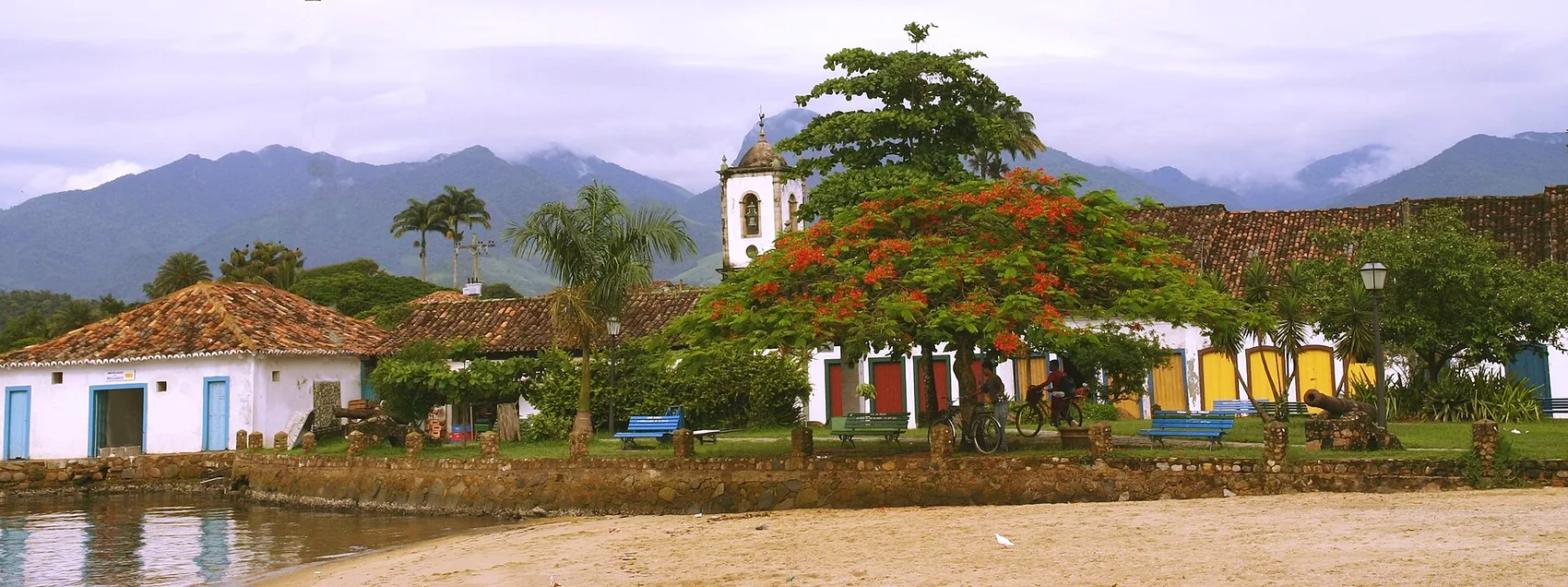
Everyone searching for a Paraty villa with a pool and a view is picturing the same thing without naming it: still water, and the whole bay beyond. Here is how to find the real version, and tell it from the pretty photographs.
Almost everyone who searches for a Paraty villa pool view is picturing the same thing without quite being able to name it: a long edge of still water, and beyond it the whole bay, the islands and the mountains laid out in the afternoon light. It is one of the most requested things on this coast and one of the least understood, because the phrase covers a dozen very different realities. A pool at sea level with a hedge in front of it is not the same as a pool on a ridge four hundred metres up with an uninterrupted sweep of the Bay of Paraty, Angra dos Reis and Ilha Grande. Both get listed with the same three words. Only one of them delivers the picture in your head.
We host on a hillside above town, so we spend a lot of our lives explaining the difference to people before they book — sometimes talking them into our own place, and honestly, fairly often talking them into somewhere else that fits their trip better. This guide is the long version of that conversation. It is about how to choose a hillside villa with a real infinity pool and a genuine bay view in Paraty: what altitude buys you and what it costs, how a beachfront house compares, why privacy matters more than square metres, and how to read a listing so the view you booked is the view you get.
The short version, before the detail: the best pool-with-a-view stays in this region are up in the hills, a few minutes' drive above the historic centre, and the thing that makes them worth the drive is the one thing the town itself cannot give you — height, and the distance to see the whole coast at once. The rest of this explains how to find the right one, and how to tell the real ones from the pretty photographs.
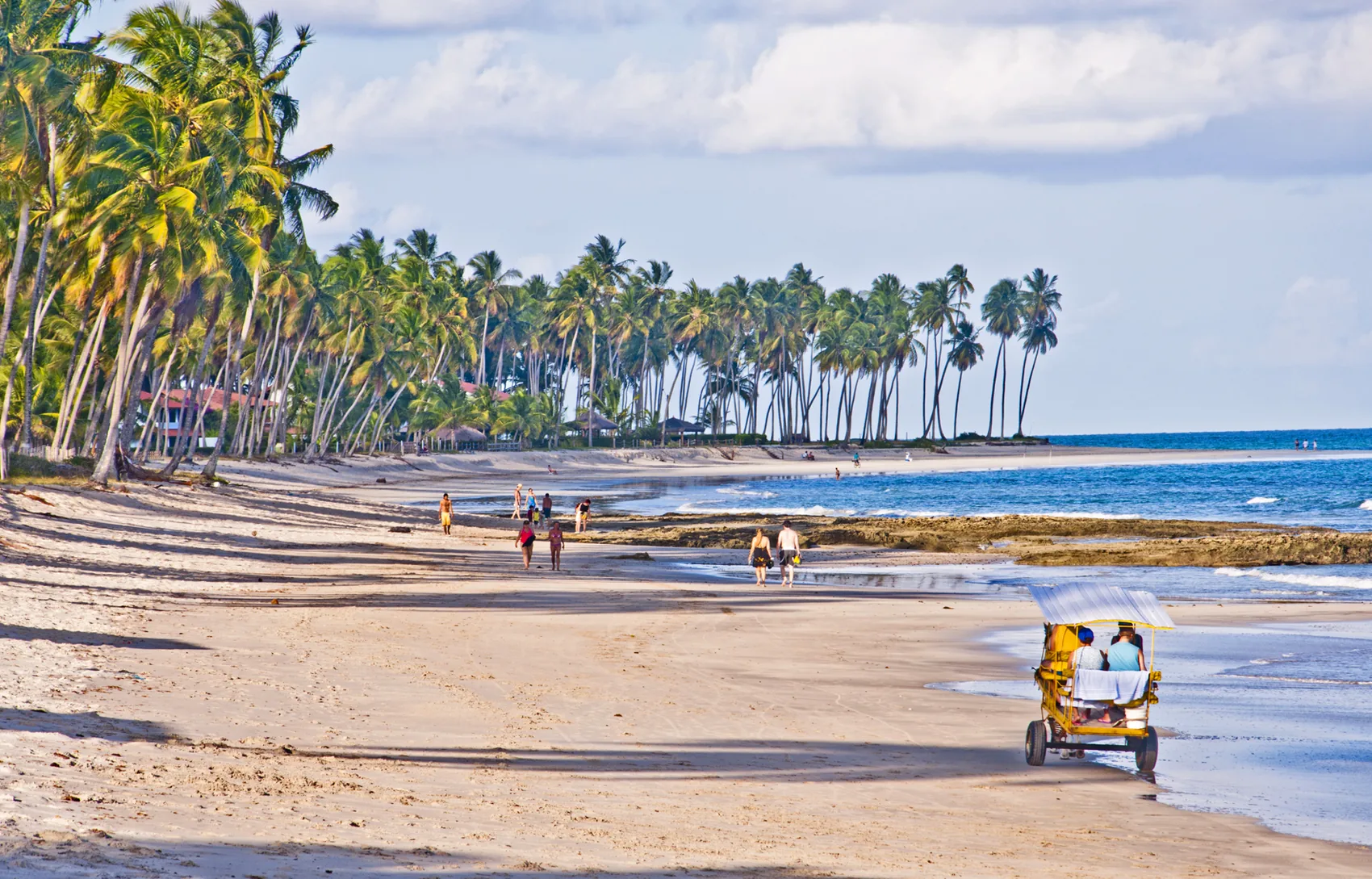
What a Paraty villa pool view actually promises
Start by pulling the phrase apart, because each word is doing real work and listings routinely deliver only one or two of the three.
Pool is the easy part, and the least interesting. Plenty of houses here have one. What matters is not that a pool exists but where it sits, which way it faces, and whether you would actually spend your day beside it. A plunge pool wedged into a side yard between two walls is a pool. It is not what you came for.
View is where the word does most of its lying. In Paraty a "view" can mean a glimpse of green hillside through the trees, a slice of neighbour's garden, a strip of sea between two roofs, or the entire bay from a clear height. All four get photographed with the same wide lens and described with the same word. The difference between them is the difference between a nice house and one you remember for years.
Villa — really, on this coast, a chalet or a private house — is the part that decides whether the pool and the view are yours alone or shared with a corridor of other guests. The whole point of renting a house rather than a room is that the water and the view belong to your group for the length of the stay. Hold those three ideas apart and you will never be fooled by a listing again.
The genuine article, the thing worth searching for, is a private house on high ground with an infinity pool positioned so that the water reads as continuous with the bay beyond it, and a view broad enough to take in more than one landmark at a time. In this region, at its best, that means a triple view — three named bodies of water and coast in a single sweep. There are not many houses that can honestly claim it, which is exactly why it is worth being picky.
Altitude versus beachfront: the choice that decides everything
This is the real fork in the road, and most people arrive at it without realising there was a decision to make. Do you want to be down at the water, or up above it? The two are not better and worse; they are different holidays. Choose deliberately and you will be happy. Drift into one expecting the other and you will spend the week faintly disappointed.
The case for altitude
Height buys you three things that sea level cannot. The first is the view itself. From a ridge a few hundred metres up, the coast stops being a beach in front of you and becomes a map: the town, the harbour, the near islands, the far shoulder of Ilha Grande, the mountains of the Serra da Bocaina running down to meet the sea. You cannot buy that perspective at any price on the flat, because the flat cannot see over its own trees. The second is air. Paraty summers are hot and humid at sea level; two or three hundred metres up, the temperature drops a few degrees, the breeze picks up, and the nights are genuinely cooler for sleeping. The third is quiet. Up in the forest the soundtrack is cicadas, birds and, at dawn, the odd troop of monkeys moving through the canopy — not scooters, bar music or the neighbour's generator.
The cost of altitude is a car and a short drive. You are not stepping out of your door onto the sand. You drive down to town for dinner and back up afterwards, and you drive to the beaches. For most guests that turns out to be a feature rather than a bug — the drive down is a few pretty minutes, and the reward is coming back up to silence and the whole bay going gold. But if the idea of a car on holiday makes you tense, be honest about that now.
The case for the water's edge
A beachfront or near-water house offers the opposite bargain, and for some trips it is the right one. You wake up and walk into the sea. There is no drive to a beach because you are on one. For families with small children who want the water twenty steps from the towel, for anyone whose ideal day is measured in how few times they had to put shoes on, sea level has an obvious pull.
What you give up is the view and, usually, the privacy and the cool air. Down on the flat, your outlook is the beach directly in front of you and the horizon — lovely, but a single plane rather than the layered sweep you get from height. You are warmer at night. And the good beachfront plots near Paraty tend to sit inside gated communities or busy stretches of coast, so "private" often means "shared with the development." A waterfront house can be wonderful. It is just a different wonderful, and it is not the one the phrase "villa pool view" is usually reaching for.
Height is the region's scarcest asset. Anyone can put a pool by the sea; only a handful of houses can put one where you see the whole coast at once.
The triple view, and why it is genuinely rare
Here is the thing that separates a good hillside pool from an extraordinary one, and it comes down to geography. Paraty sits at the western corner of a large, island-scattered bay, the mouth of which is closed off by Ilha Grande lying across the horizon. Just to the north, the coast folds into the bays and islands of Angra dos Reis. From most places you can see one of these things. From the right ridge, at the right height, facing the right way, you can see all three in a single frame: the Bay of Paraty in the near ground with its schooners and near islands, the Angra dos Reis coast curving away to the north, and the long green back of Ilha Grande closing the far horizon.
That is the triple view, and it is rare for boring, physical reasons. You need enough height to see over the near hills, a slope that faces the open bay rather than back into the mountains, and a plot without a taller ridge or a stand of forest blocking the sightline. Most houses fail at least one of those tests. They have height but face the wrong way; or the right aspect but sit too low; or the perfect angle with a neighbour's land rising in front. When a property genuinely delivers the three-way sweep, it is because someone chose that exact spot for that exact reason, and built the deck and the pool to point at it.
Why does it matter beyond bragging rights? Because a layered view changes through the day and never gets boring. A single beach in front of you is the same at nine as it is at five. A three-body sweep gives you schooners crossing the near water in the morning, the light moving across the Angra islands at midday, and Ilha Grande turning blue and then violet as the sun drops behind it. You watch it the way you watch a fire. That is what people are really paying for when they pay for a view, whether or not they could have told you so in advance. Our complete guide to Paraty maps how the whole bay fits together if you want to see where the pieces sit.
What makes an infinity pool actually work
The word "infinity" gets stuck on any pool with a raised end these days, so it helps to know what you are really looking for. A true infinity, or vanishing-edge, pool has one lip built exactly to water level so the surface appears to run off into the space beyond. Positioned well, on a height, the water reads as continuous with the bay behind it — the pool becomes the near edge of the sea. Positioned badly, it is just a pool that spills over one side. The magic is entirely about what sits beyond the vanishing edge.
Orientation and the light
The single most important question about a pool here, after "what is beyond the edge," is "which way does it face." A west-facing deck gives you the sunset over the water, which is what most people picture and what makes the end of the day the best hour of it. An east-facing pool gives you sunrise and shade in the afternoon, cooler for a midday swim but a duller evening. North is a safe all-day bet in the southern hemisphere. Ask, and if a listing cannot tell you the aspect, that tells you how carefully the place was thought through.
Edge, depth and temperature
A few practical things separate a pool you use all day from one you photograph and avoid. A generous flat deck or lawn around it, with shade you can retreat to, matters more than the pool's size — you spend more hours beside the water than in it. Depth matters for families: a shallow shelf or a gentle step-in end is worth asking about if you are travelling with small children. And in the cooler months, from about June to August, an unheated pool on a hill can be brisk; if a warm swim in winter matters to you, ask whether it is heated rather than assuming. None of this shows up in a wide-angle photograph, and all of it decides how much you actually swim.
A quick test for any "infinity pool" listing: ask for a photo taken from water level at the vanishing edge, looking out. If the pool truly sits on a height with a real view, that shot is stunning and the host will have it. If they only ever send the pool photographed from the far side looking back at the house, the edge probably vanishes into a hedge, not a bay.
Privacy: the quiet luxury people underrate
Ask guests afterward what they loved most and it is rarely the thread count or the pool's dimensions. It is that the place was theirs. No corridor, no other guests at the far loungers, no wondering whether the family next door can see into the pool. On a hillside plot surrounded by its own forest, privacy is close to total: you can swim before breakfast without dressing, eat dinner on the deck with the whole bay to yourselves, and hear nothing man-made for hours. That is a genuinely scarce thing, and it is the part of "luxury" here that has nothing to do with money spent on finishes.
Privacy is also where hillside houses beat both hotels and beachfront developments decisively. A gated beach community gives you security but not solitude — you share the beach, the paths, the sightlines. A hotel, however lovely, is a set of rooms off shared space. A private house on its own slope, screened by trees, gives a couple, a family or a group of friends something none of those can: the feeling of having borrowed a beautiful home rather than checked into somewhere. If you are weighing the wider question of where to base yourself, our guide to choosing a luxury rental in Paraty goes through every type of stay and who each suits.
The short drive above town, honestly assessed
Let us be straight about the one real trade-off of a hillside pool villa, because it is the thing people worry about and the thing that turns out to matter least. You will need a car, and you will drive a few minutes down a hill road to reach the historic centre, the restaurants and the beaches. In practice this is a short, scenic descent, not an expedition. You go down for dinner and the evening's music, and you come back up to quiet and the lights of the bay below you.
The reasons it matters less than people fear: Paraty's centre is small and closed to cars anyway, so wherever you stay you park at the edge and walk in. The beaches worth visiting mostly need a drive or a boat regardless of where you sleep. And the "cost" of the drive is paid back every night, when you leave the crowds and the heat behind and climb into cool air and silence. Guests who arrive fretting about the car almost always end the week describing the drive up as one of their favourite parts of the day. That said, if you genuinely will not rent a car and refuse to use transfers, a hillside house is the wrong choice and a central pousada is the right one — and we would tell you so. Our notes on getting around the region lay out the options in full.
Reading a listing: telling a real view from a lens trick
A camera is a professional liar, and villa photography is an art form built on flattering angles. Here is how we would teach a friend to see through it before they pay a deposit.
- Demand a photo of the view, not of the house. Marketing galleries are full of the pool, the kitchen, the bedrooms. The one shot that matters is the actual outlook from the deck, taken on a normal day, ideally as a wide phone photo rather than a drone shot. A drone photographs a view no guest will ever stand in. Ask what you will see with your feet on the deck.
- Ask for the aspect and the height. Which direction does the pool face, and roughly how high is the property above the sea? A confident host answers in one line. Vagueness here is a warning.
- Name the landmarks. If a place claims a bay view, ask what specifically you can see — the town, which islands, whether Ilha Grande is visible. Real views come with real names attached. A "sea view" that cannot name a single thing in it is usually a sliver of water between roofs.
- Watch for the crop. Wide lenses make small decks look vast and hide the neighbour ten metres away. Ask what is immediately to the left and right of the pool, and whether the house is overlooked.
- Ask for a photo from your season. The bay that sparkles in a December brochure can sit under grey afternoon storms in the wet months. A recent image from the time of year you are coming is worth more than the whole polished gallery.
A host who answers all five plainly, without getting defensive, is very likely running a real place. One who deflects is telling you something too. The quality of the answers before you pay is the most reliable preview of the stay you will get.
The pool, hour by hour and season by season
Part of what you are buying with a pool-with-a-view house is a whole rhythm to the day, so it is worth picturing how the water actually gets used across the hours and the calendar.
Through a day
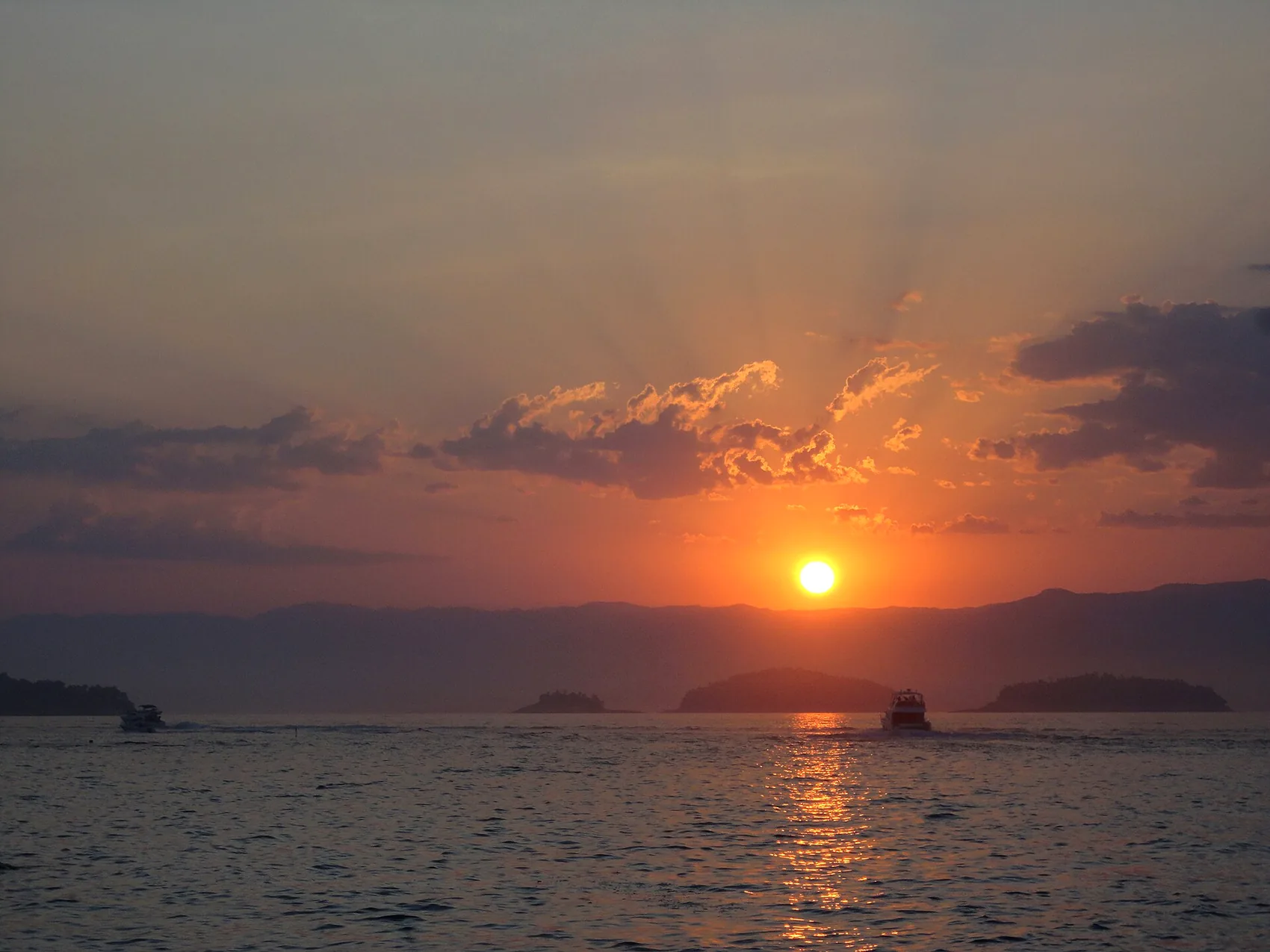
Early, before the heat, the pool is glass and the bay below is often laid with mist that burns off as the sun comes up — the best swim of the day is usually the first one, alone, before anyone else is awake. Midday is for the shade beside the water rather than the water itself, because the sun on this coast is strong and the smart move is a covered deck, a book and a cold drink until it softens. Late afternoon is the pool's finest hour: the light goes long and gold, the heat eases, and a swim as the sun drops toward Ilha Grande is the thing people remember. After dark the deck becomes the living room — dinner outside, the bay a scatter of lights below, the water lit and quiet.
Through the year
The Brazilian summer, from December through Carnival, is hot, green and lively, with warm water and the occasional heavy afternoon downpour that clears as fast as it arrives. This is peak season, when the best houses book out months ahead. The shoulder months — roughly April to May and September to November — are the quiet value stretch: warm enough to swim, far fewer people, and the same house often at a lower rate. The dry winter, June to August, brings the clearest air and the sharpest views, cooler nights that are perfect for sleeping up in the hills, and pool water that can be brisk unless it is heated. The full season-by-season logic is in our guide to the best time to visit Paraty, and if you are weighing how long to come, how many days you need in Paraty is the honest read.
Who a hillside pool villa suits
This kind of house is not right for every trip, and it is worth being honest about who it serves.
Couples
For two people it is close to ideal, provided you want privacy over immersion. The pool, the deck and the view make the house itself the destination, which is exactly what you want for a honeymoon, an anniversary or simply a week of not being anywhere near other people. You drive down for the dinners and the music you want and retreat from the rest. Couples who would rather be in the lantern-lit streets every single night should weigh a central stay instead; our honeymoon guide and romantic ideas cover both instincts.
Families and groups
A private house with several bedrooms, a pool and outdoor space beats a set of hotel rooms decisively for a family or a group of friends. Children swim while the adults talk; everyone has their own bathroom; you can cook and eat at home on the nights nobody wants to drive down. The pool becomes the centre of the day and keeps children happily occupied between outings, which is worth a great deal on a beach coast where the best sand needs a boat or a walk. Check the pool's shallow end and fencing if you are travelling with toddlers; our Paraty with kids guide has the detail.
Solo travellers and remote workers
A house on a quiet hill is a fine base for one person too, especially anyone mixing a stay with remote work: cool air, silence, a pool to break up the day and a view to work in front of. Confirm the internet before you commit if you need to stay reachable — hill properties vary, and a good host will tell you the real speed rather than the optimistic one.
Getting here, wherever you are coming from
Where you are travelling from changes the shape of the arrival, so factor it into the plan.
From Rio de Janeiro, Paraty is roughly a four-hour drive down the coastal road, one of the prettier highway runs in the country once it meets the sea. Many guests hire a car in Rio, which also solves the hillside-house question of needing wheels once here, or take a comfortable coach and arrange a transfer up to the house. The route and the choices are in our getting here from Rio guide.
From São Paulo, allow around five to six hours by road depending on traffic out of the city and the coast road's summer crowds. Paulistano guests often make it a long-weekend habit; the practicalities are in getting here from São Paulo.
From abroad, you fly into Rio or São Paulo and continue overland, since Paraty has no commercial airport of its own. The cleanest version is to land, spend a night in the arrival city to shed the flight, and drive or transfer down the next day rather than doing it all in one go. Our flying-to-Paraty guide covers the airport and onward options. However you come, a good host will send precise directions and a map pin — up in the hills the turnings are often unmarked, and directions are worth more than any address.
The questions that actually decide the booking
Beyond the view-specific checks above, a handful of questions separate a stay that works from one that surprises you. Ask every one, and judge the host as much by how they answer as by what they say.
- Where exactly is it, and what is the access road like? Ask for a pin, and ask whether a normal car manages the climb or whether the last stretch is steep or unpaved. Some hill roads want a higher vehicle.
- How many does it really sleep, in real beds? A house listed for ten may be perfect for six. Ask how many rooms are proper suites versus sofa-beds.
- What is included? Daily cleaning, a welcome breakfast, the option of a cook, a boat day, an airport transfer. The answer is the difference between a rental and a hosted stay.
- Is the pool heated, and which way does it face? Decisive if you are coming in winter or you care about the sunset.
- What are the house rules and the minimum stay? High season often carries multi-night minimums and stricter cancellation terms, for understandable reasons.
- Who do I actually talk to? The single best predictor of a good stay is a responsive, straight-talking host. Slow and vague before you have paid is your answer.
A day at a pool with a view, in practice
To make all of this concrete rather than abstract, here is the shape a day tends to take in a well-chosen hillside house — not a schedule, just the rhythm guests fall into within about forty-eight hours of arriving. You wake early, because the light does it for you, and the first swim is a quiet one before breakfast with the bay still under mist. Breakfast is slow, on the deck, watching the first schooners cross the near water. Mid-morning you might drive down for a boat day on the bay, an island beach or two and a seafood lunch behind the sand, back up by late afternoon; or you might not move at all, and let the pool and the shade and a book be the whole plan. The heat of the early afternoon sends everyone to the covered part of the deck. Around five the light goes gold and the best swim of the day happens with the sun dropping behind Ilha Grande. Dinner is either down in town among the cobblestones and the music, or cooked at home and eaten outside with the whole coast lit below you. Then the deck, the dark, the cicadas, and the bay reduced to a scatter of lights. Do that for three days and the house stops being where you are staying and becomes, briefly, where you live. That, more than any single feature, is what a pool with a view is for.
Beyond the pool: what the location puts within reach
A pool with a view is the anchor of the trip, but the hills sit above one of the richest stretches of coast in Brazil, and a good week uses both. From a hillside base you are minutes from the colonial centre and its churches, a short drive from the waterfalls and cachaça distilleries in the hills behind town, and a boat ride from the bay's islands and the beaches of Ilha Grande on the horizon. The pleasure of a house up top is that all of it is a day trip you return home from — you go out into the region and come back to your own quiet water each evening. Our explore pages lay out the days worth building around, and the journal goes deeper on the ones we love most.
Common mistakes people make
- Booking a "pool view" without checking what is beyond the edge. The three words are cheap. The reality ranges from a hedge to the whole bay. Always ask for the outlook photo from the deck.
- Choosing the hills, then resenting the drive — or the beach, then resenting the lack of a view. Both are fine choices. The mistake is not matching the choice to how you actually want your evenings to go.
- Trusting a drone shot. A drone photographs a perspective no guest will ever stand in. Judge a place by the view from where your feet will be.
- Underestimating the season. A house that is a bargain in May is a different animal, and price, over New Year. Book early for the summer holidays; lean on the shoulder months for value.
- Ignoring the host. The building is fixed; the host is the variable that makes or breaks the week. Choose the responsive, specific one.
Our own answer, stated plainly
We will not pretend to be neutral. Chalé Bel Air exists because we believe the best thing this coast can give you is the view from height — the Bay of Paraty, the Angra dos Reis islands and Ilha Grande in one sweep, with an infinity pool set at the edge of it and the town a few quiet minutes below. That is a hills-and-view answer to the whole question, and it will not be right for everyone. If your trip is about being in the lantern-lit streets every night with no car, a pousada in the centre is the better call, and we will happily point you to one. If it is about the pool, the privacy and waking up above the bay, that is exactly what the chalé was built for.
Either way, the way to find out is to tell us what you are picturing. Send your dates, your group and a sentence about the trip you have in mind, and we will give you a straight answer about whether this is the right pool with the right view for it — or where else on the coast might fit better. You can write to us here; we answer personally, and we would always rather send you to the right place than the nearest one. If you want the wider picture first, the resources page gathers everything worth reading before you come.
Come stay above the bay
Chalé Bel Air sits on the ridge that looks over everything in this guide. Tell us your dates and what kind of trip you are after — we answer personally.
Ask about your datesFrequently asked questions
What is a Paraty villa with a pool view?
It is a private house, usually a hillside chalet a few minutes above the historic centre, with an infinity pool set so the water reads as continuous with the bay beyond it. The best examples sit on high ground with a broad, layered outlook rather than a single strip of sea. The phrase gets used loosely, so the thing to check is always what sits beyond the pool's edge.
Is it better to stay in the hills or on the beach in Paraty?
They are different holidays. The hills give you height, cool air, privacy and a sweeping view, at the cost of a short drive to town and the beaches. The water's edge gives you a swim off your doorstep but a flatter view, warmer nights and, often, a shared setting inside a development. For a pool-and-view trip the hills win; for children twenty steps from the sea, the beach has a real pull.
What is the triple view in Paraty?
From the right ridge, at enough height and facing the open water, you can see three things at once: the Bay of Paraty with its islands in the near ground, the Angra dos Reis coast curving away to the north, and the long back of Ilha Grande closing the horizon. Most houses see only one of these, which is why a genuine three-way sweep is rare and worth being picky about.
Do you need a car for a hillside villa in Paraty?
In practice, yes. A house in the hills assumes a car for the drive down to town and out to the beaches and waterfalls. The drive is short and scenic, and the centre is closed to cars anyway, so you park at its edge wherever you stay. If you genuinely will not drive or use transfers, a central pousada is the better fit than a hillside house.
Are the pools at Paraty hillside villas heated?
Some are and some are not, so ask rather than assume. In the Brazilian summer an unheated pool is warm and pleasant. In the dry winter, from about June to August, an unheated pool on a hill can be brisk, so if a warm swim in the cooler months matters to you, confirm that it is heated before you book.
When is the best time to book a Paraty villa with a pool and a view?
The summer holidays, late December through Carnival, are peak season with the highest rates and longest minimum stays, and the best houses fill months ahead, so book early. The shoulder months, roughly April to May and September to November, are the value sweet spot, with warm water, fewer people and lower rates. The dry winter brings the clearest air and the sharpest views.
Is a hillside pool villa good for families?
Very. A private house with several bedrooms, a pool and outdoor space beats a set of hotel rooms for a family: children swim while adults talk, everyone has their own bathroom, and you can cook and eat at home on the nights nobody wants to drive down. Check the pool's shallow end and any fencing if you are travelling with small children.